[Editor’s Note: The Army Mad Scientist Initiative is excited to feature another article from Mr. Jonathan Tyrrell, this time on quantum computing and its potential effects on the evolution of warfare. In this piece, Mr. Tyrrell explores how the race for absolute-zero processing and Helium-3 supply chains is rapidly shifting our strategic geography. He warns that the threat of “harvest now, decrypt later” tactics and automated decision-making could soon force us to redefine our ethical rules of targeting and distinction. — Read on!]
Disclaimer: The views expressed in this article are those of the author and do not reflect the official policy or position of the Department of War, the Department of Defense, the U.S. Army, or the U.S. Government.
A Week in October
In the first week of October 2026, the U.S. Army did two things that would have sounded like a pitch for a 1984 summer blockbuster. On October 1, more than 600 Soldiers reclassified into 40D, Tactical Space Operations Specialists, the first enlisted career field in the Army’s new Space Operations branch. The next day, at Fort Bragg, ten warrant officers graduated as the first 390A Robotics Technician Integrators, a Special Forces job the rest of the service is already eyeing.
Space Soldiers on Thursday. Robot wranglers on Friday. Somewhere a screenwriter who pitched this in 1985 is owed an apology.
None of this is science fiction anymore, which is the problem. Every transformative technology eventually acquires a geography, and every geography eventually acquires a target folder. Quantum computing is next in line. The nuclear age gave strategists silos and enrichment plants. The information age added undersea cables and data centers. The quantum age offers something stranger: a machine kept colder than deep space, inside a building that looks like a community college science wing, run by a few hundred people who may be the only humans alive who can turn it on. Fans of Sneakers will recall that the most dangerous object in that movie was a little black box that could break any code. Robert Redford kept his sense of humor. The rest of us may not be so lucky.

This essay asks four questions. What do these machines need? What do they threaten? How does their concentration change the ethics of targeting? And what do we owe each other before the shooting starts?
What the Machine Needs
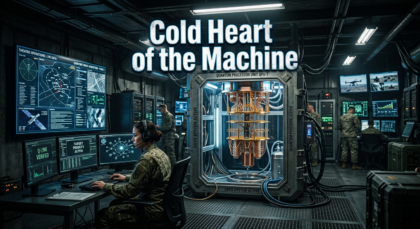
It is tempting to picture quantum computers clustered somewhere with mild weather and calm bedrock, like a retirement community for qubits. The reality is less scenic. The machine brings its own climate. Most leading superconducting systems live inside dilution refrigerators that hold the processor at roughly 10 to 20 millikelvin, a hair above absolute zero. A fridge in Phoenix and a fridge in Helsinki reach the same temperature. Mr. Freeze would be jealous.
Vibration matters, since a passing truck or a stray cosmic ray can ruin a computation, but engineers solve that with building design, not by finding a continent without fault lines. The machine is less San Andreas and more princess and the pea.
So the real strategic geography is about dependencies, not latitude: talent concentrated in a few university and corporate clusters; supply chains for helium-3, which on Earth comes mostly from the decay of tritium in nuclear weapons programs; power and cooling that can never blink mid-computation; and classical supercomputers next door, since quantum processors work in tandem with them.
That distinction carries moral weight. A target defined by geology could be avoided. A target defined by human expertise and civilian supply chains is woven through ordinary life, like the guy in Office Space who still has a desk even though nobody remembers hiring him.
Race to the Moon 2.0
One dependency deserves its own sequel. Helium-3 is scarce on Earth. On the Moon, four billion years of solar wind have embedded it in the dust. Anyone who saw Duncan Jones’s Moon in 2009 will remember Sam Rockwell alone on the far side, harvesting helium-3 and slowly discovering that his employer had not been entirely candid with him. That film is now less a parable and more a business plan.
In 2025 the Seattle firm Interlune signed agreements to sell lunar helium-3 to the U.S. Department of Energy and to Maybell Quantum. Bluefors, the Finnish company whose refrigerators cool most of the world’s quantum machines, followed with an order for up to 10,000 liters a year from 2028 to 2037, reportedly worth more than $300 million. A dose of candor: lunar helium-3 is plentiful in total but thin in concentration. By Interlune’s own estimate, a swimming pool’s worth of regolith yields about three liters of gas, and nobody has done this on the Moon yet.

The strategic logic does not wait for the engineering. If quantum computing becomes a pillar of national power and helium-3 its bottleneck, the Moon joins the supply chain. The 1967 Outer Space Treaty forbids nations from claiming celestial bodies but says remarkably little about scooping them up and shipping them home. The world has already split into two clubs, the U.S.-led Artemis Accords and the China-Russia International Lunar Research Station, both eyeing the same south polar neighborhood. This is the part of the movie where the music changes.
The first space race was about prestige and missiles. The second may be about who controls the cold. With the Army now fielding an enlisted space branch, who fights in that domain is no longer hypothetical. A future quantum conflict could start over a crater 384,000 kilometers away, with no settled law, no referees, and no civilians to protect except the ones we send. Ask Sam Rockwell how that goes.
The Threat That Reaches Backward in Time
The signature danger is cryptographic. In 1994 Peter Shor showed that a large, error-corrected quantum computer could factor the enormous numbers behind most public-key encryption. RSA and elliptic-curve systems, which guard banking, diplomatic cables, and military networks, would fold like a lawn chair. In Sneakers, the codebreaking project’s name was an anagram for “too many secrets.” Shor’s algorithm is that joke with a proof.
No machine today can do this at scale. That offers less comfort than it should, thanks to a strategy called “harvest now, decrypt later.” Adversaries can vacuum up encrypted traffic today and park it until a capable machine arrives. Secrets that must hold for twenty years are already compromised if the breakthrough comes in ten.
This produces a moral structure Doc Brown would appreciate. Most wrongs happen at a moment. Quantum decryption is a wrong whose act lands in the future but whose preparation, and whose victims, exist now. The source unmasked a decade later, the dissident whose messages get reread, the soldier whose movements are reconstructed: each is harmed by a decision made long before the harm arrives. The DeLorean, it turns out, runs on stolen data.
It also creates a dangerous incentive. The first nation to reach cryptographically relevant capability gets a brief window of advantage before the world migrates to post-quantum encryption, which NIST began standardizing in 2024. Brief windows tempt a leader to act before they close and tempt rivals to strike before they open. The ethics of quantum conflict are ethics of timing, and the just war tradition’s thinking on preemption is about to get a stress test. The obligation is not complicated: migrate to post-quantum cryptography now, as a duty to everyone whose data already sits in somebody else’s archive. Which is, statistically, you.
Concentration and the Principle of Distinction
The law of armed conflict rests on distinction. Combatants and military objectives may be targeted. Civilians may not. Quantum computing scrambles that line in three ways.
First, ownership is mixed. Much of the best quantum hardware belongs to companies and universities, often partly funded by defense agencies. A single facility might simulate a cancer drug in the morning and chew on signals intelligence in the afternoon. It is the Swiss Army knife problem, except one of the blades is a strategic weapon.
Second, the critical asset is human. A dilution refrigerator can be rebuilt in months. The physicists who can calibrate a thousand-qubit processor took a decade to train. Strategists will be tempted to conclude that the people are the real center of gravity, a road that runs over the protections civilians are owed and erodes the old norm separating knowledge from combat. Real Genius taught a generation that the kids in the lab might be building something the Pentagon wants. It did not suggest the answer was to make the kids a target.
Third, concentration invites catastrophe thinking. If a nation’s quantum capability lives in three buildings, an adversary may conclude that destroying them in the opening hours would decide the war. Every Gen Xer knows what happens to a superweapon with one small, poorly defended weak point. That logic made vulnerable nuclear forces so dangerous during the Cold War, and it was answered with dispersal, hardening, and arms control. Not with a farm boy and a proton torpedo.
The ethical response is not to pretend these facilities lack military value. It is to insist that military value be established by actual function rather than potential, and that civilian researchers weigh heavily in every calculation.
Proportionality and the Weight of Lost Futures
Proportionality asks whether expected civilian harm is excessive compared to the concrete military advantage anticipated. Quantum facilities strain both sides of the scale. On the advantage side, planners will be tempted to count speculative gains. But a rule that permits strikes against potential capability has no natural stopping point. Nearly every physics department holds potential. So does every eighth grader with a library card.

On the harm side, the losses travel beyond the blast radius. Quantum computers promise advances in drug discovery, materials science, and climate modeling. A strike that ends a research program may cost lives that are never counted, because they belong to people who would have been saved by medicines never discovered. No battle damage assessment has a column for that. And if quantum labs become routine targets, every nation’s incentive is to classify and wall off the field, until the most important research of the century ends up like the Ark at the end of Raiders: crated, stamped, and wheeled into a warehouse by “top men.”
A sound framework would treat quantum research infrastructure much as we treat hospitals and cultural property. Not immune, but protected by a strong presumption that only clear and direct military use can overcome.
Moral Injury at a Distance
This is the section where the movie references stop, because the subject earns it.
The people who plan, approve, and execute strikes against quantum infrastructure will carry those decisions home. Moral injury, the wound from taking part in or failing to prevent acts that violate one’s deepest convictions, is not limited to close combat. Drone operators taught us that distance does not dissolve conscience.
Quantum conflict intensifies this in two ways. The first is abstraction. A planner may authorize destroying a facility based on probabilistic assessments of a capability no one has seen work. If the intelligence was wrong, the researchers who died were killed to prevent a threat that never existed. The second is recognition. Many officers and analysts share the educational backgrounds of the scientists on the other side. Targeting someone whose work you admire is a distinct burden, and our formation programs rarely prepare people for it.
Commanders and chaplains should get ahead of this. A force that cannot talk about these burdens before the fight will struggle to heal from them after it.
When the Machine Decides Faster Than the Republic
Remember the opening of WarGames? Two officers in a missile silo get a launch order, and one hesitates. The brass conclude the problem is the human, pulls the people out of the loop, and hand the keys to a computer called WOPR. Matthew Broderick and a game of tic-tac-toe save the world. We should not assume we will be that lucky twice.
Quantum computing will not arrive alone. It arrives alongside super intelligence, and the pairing should give any citizen of a democracy pause. The Army’s new 390A integrators exist because autonomous systems are moving from the lab to the line. SI already compresses the cycle of observing, deciding, and acting. Quantum may compress it further. The natural response is delegation: let the system flag the threat, recommend the strike, and sometimes execute the response. Each step is defensible alone. Together they move the decision to use force out of human hands and into a pipeline. Skynet did not become self-aware in one dramatic moment. It got there through a series of perfectly reasonable procurement decisions.
Financial markets offer a warning. Automated trading has produced flash crashes, cascades of machines reacting to machines, over in minutes before any human understood what happened. A flash war would follow the same logic with lethal stakes. Dr. Strangelove made this joke in 1964. It has not aged into something funnier.
This is a special danger for democracies, because democracy is slow on purpose. Civilian control, congressional war powers, public debate, and a free press all take time. That friction is how a free people consents to the gravest act a nation can take. A doctrine that treats deliberation as a vulnerability to be engineered away quietly transfers sovereignty from citizens to systems, and from accountable officials to whoever wrote the decision rules. And when an automated response kills, who answers for it? A democracy that cannot assign blame cannot correct its course.
Department of Defense Directive 3000.09 directs appropriate levels of human judgment over the use of force. That principle deserves fierce defense, because every potential future pressure to relax it could be framed as necessity. Speed is a military advantage. It is not a moral argument.
Obligations Before the Fight
The time to settle these questions is before the first strike, while reason can still outrun fear. Six obligations follow.
- Defend by migration, not only by force. Adopt post-quantum cryptography across government and critical infrastructure. Every system migrated shrinks the incentive to strike first.
- Disperse and harden. Spread quantum resources across sites and separate military workloads from civilian research. No single exhaust ports.
- Define military objectives by function. Require evidence of actual military use before a quantum facility becomes a lawful target. Potential is not enough.
- Protect the people. Scientists remain civilians unless they directly take part in hostilities. Hold that line in doctrine and training.
- Pursue norms early, on Earth and beyond it. Start talking about restraint now, from research transparency to rules for lunar extraction. Arms control worked in the nuclear age only after decades of near misses.
- Keep the decision to use force human and accountable. Protect the deliberate pace of lethal decisions and refuse to let speed substitute for consent.
A quantum computer is built to live in uncertainty, holding many possibilities until observation forces one outcome. Our moral situation looks a lot like that. Many futures are still open, and the choices made this decade will collapse them into one. WOPR eventually learned, by playing tic-tac-toe against itself, that the only winning move is not to play. It would be nice to reach the same insight with fewer near misses and no Matthew Broderick required.
 If you enjoyed this post, check out the T2COM G-2’s Operational Environment Enterprise web page, brimming with authoritative information on the Operational Environment and how our adversaries fight.
About the Author: Jonathan Tyrrell is a U.S. Army Reservist, Ordained Minister, former history teacher and strategic foresight analyst whose work spans military ethics, AI governance, and nuclear command authority. He holds degrees from Drew University, the London School of Economics, Princeton Theological Seminary and Liberty University. He is currently completing post graduate research at the University of Edinburgh on the intersection of Science, Philosophy and Religion.
Disclaimer: The views expressed in this blog post do not necessarily reflect those of the U.S. Department of Defense, Department of the Army, or the Transformation and Training Command (T2COM).
Sources
- Army codifies decades of space expertise, welcomes over 600 Soldiers to new Space Operations branch, Soldier Systems
- Army Special Forces graduate first Robotics Technician Integrators (390A), DefenseScoop
- Interlune secures helium-3 agreements with Maybell Quantum and U.S. DOE, Quantum Computing Report
- Bluefors to source helium-3 from the Moon with Interlune, Bluefors
- Bluefors enters deal to secure lunar helium-3 supply, The Quantum Insider
- Interlune moon mining plans, GeekWire