

[Editor’s Note: Army Mad Scientist launched its CALLING ALL CREATORS Multi-Media Contest on 10 December 2025 with the following Army Transformation Challenge:
Contemporary conflicts around the globe have demonstrated the ever-increasing speeds at which warfighting innovations are being fielded — granting a combatant decisive battlefield advantage — until effective  counter-measures are fielded by an adversary. These rapid cycles of innovation and counter-innovation currently provide only a few weeks (at best) of advantage.
How can the U.S. Army and Joint Force break this cycle and field robust and resilient capabilities that provide enduring battlefield advantage?
We received a total of 29 contest entries, running the gamut of multi-media — from haikus, illustrated poems, and riddles; images and posters; comics and graphic stories; a video, illustrated essays, Fictional Intelligence (FICINT) stories/scenarios, an interactive web experience, and even a strategic decision game! To everyone who took the time to consider our challenge, then craft and submit an entry, please accept a hearty Mad Scientist “Thank you!”
Today’s post features the WINNING submission from our newest proclaimed Mad Scientist, Professor Kristan Wheaton from the U.S. Army War College! Professor Wheaton’s submission, Vision to Victory, is a strategic decision game that explores the kinds of policy decisions necessary to field robust and resilient capabilities that provide enduring battlefield advantage. Additionally, this post highlights user experience insights from our very own Mad Sci team.
If you would like to play Vision to Victory, download the code here. It is designed for one player vs the computer and takes about 20-30 minutes. — Enjoy!]
“Stop chasing capabilities. Build the institution that outthinks every adversary.”
Every capability has a shelf life. The Army’s modernization cycle, requirements, procurement, fielding, and obsolescence takes years. Adversaries and commercial industry move in months. No specific technology provides enduring advantage because every technology eventually diffuses, degrades, or gets countered. The only thing that compounds faster than it decays is how an institution thinks, learns, and adapts. Institutional adaptive capacity is the capability that fields all other capabilities.
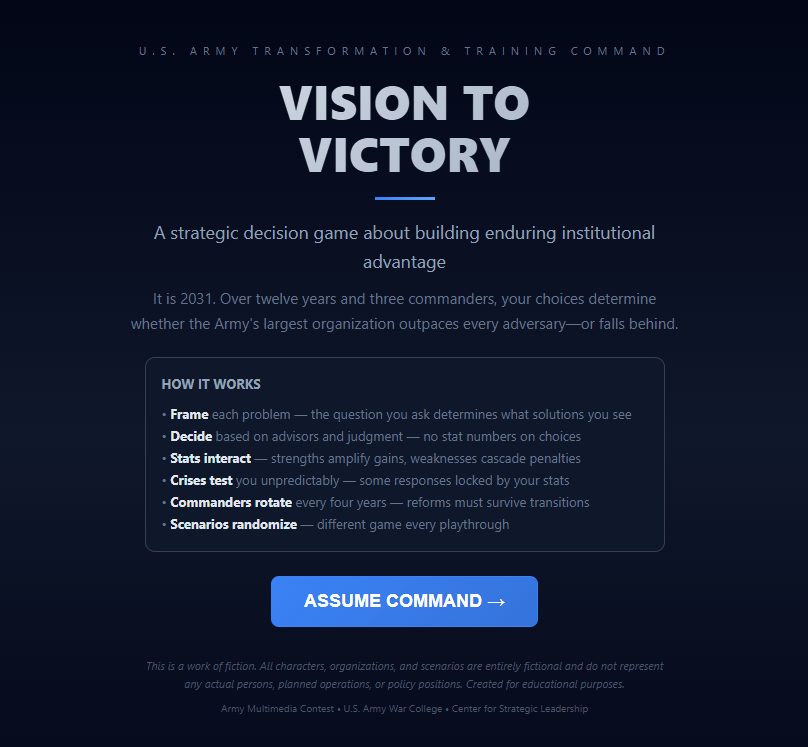
Vision to Victory makes this argument experientially. Players command a fictional Army transformation organization across twelve years and three commanders, making strategic decisions about training reform, talent management, acquisition strategy, allied integration, and force design. The game teaches what no briefing can: that the answer to the contest question is not a program, a platform, or a technology. It is institutional architecture, the cognitive infrastructure that lets the Army absorb innovation faster than any adversary, regardless of what that innovation turns out to be.
Why a game? Because the insight only works if you discover it yourself. Players who chase specific capabilities (Decision Dominance, Strategic Partnerships) perform well early but plateau. Players who invest in how the institution frames problems and develops leaders unlock compounding returns that survive commander transitions and crises alike. The lesson emerges from play, not from instruction which is exactly how adults learn strategic concepts. Twelve years of simulated decisions produce an intuition that twelve pages of analysis cannot.
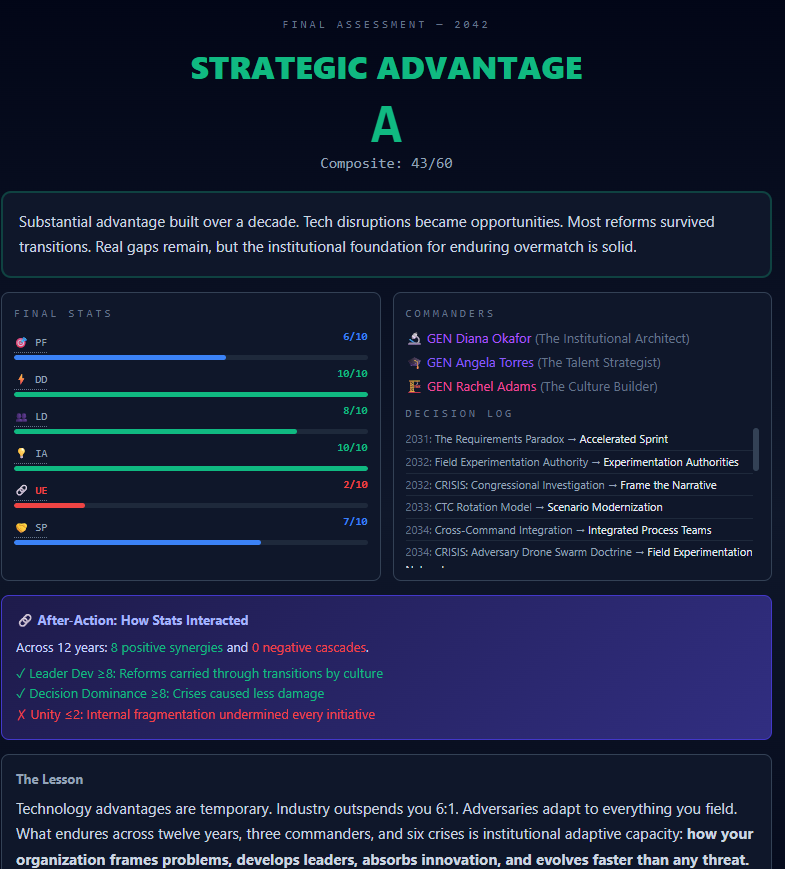
How it works. Six institutional stats interact dynamically: high Problem Framing amplifies every other gain; strong Leader Development carries reforms through leadership transitions; weak stats cascade into institutional failure. Randomized crises test what players actually built and lock out responses they didn’t prepare for. Players see greyed-out options they could have unlocked, creating the regret that drives replay, learning, and deeper strategic thinking. Commander transitions impose realistic institutional decay: reforms embedded in culture persist, but reforms tied to a single leader’s attention erode. Three transitions in twelve years teach the hardest lesson in institutional change: the difference between compliance and culture.
What makes it different. The game is grounded in research from the Prof. Kristan J. Wheaton’s Ecology of Questions framework, which draws on 54 questioning traditions spanning 2,500 years to identify how institutions think well under uncertainty. Before each decision, players choose a framing question and that question determines what options become visible. The best question is not always the most detailed one. Sometimes a short reframe (“What assumptions about combat are embedded in our evaluation criteria?”) outperforms a thorough-sounding question that accepts flawed premises. Players learn that the question the commander asks is the commander’s irreducible contribution. The one thing AI cannot replace.
The bottom line. The Army breaks the cycle by building an institution whose primary capability is redesigning itself. Technology advantages are temporary. Industry outspends you. Adversaries adapt to everything you field. What endures is institutional adaptive capacity: how the Army frames problems, develops leaders, absorbs innovation, and evolves faster than any threat. Vision to Victory lets players discover this for themselves and carries that insight back to the organizations they lead.
Mad Sci User Experience:
For the user, Vision to Victory is able to emulate the cognitive and informational overload that happens often when in senior military leadership. The game immerses the player in a high-stakes environment, balancing conflicting advice from stakeholders like the Army Chief of Staff, field commanders, and congressional committees. This design successfully shifts the player’s focus away from simple tactical victories, forcing them instead to navigate the grueling bureaucratic and political realities of steering a four-star Army command over a twelve-year horizon.
An essential strategic insight from the simulation’s architecture is its “Problem Framing” mechanism, which serves as a prerequisite for decisionmaking. Instead of simply presenting a list of solutions to a crisis, the game forces the commander to first choose how to perceive the problem, rewarding those who reframe underlying assumptions rather than treat surface-level symptoms. For example, during the “Field Experimentation Authority” scenario, framing the issue as a compliance violation yields standard bureaucratic responses aimed at enforcing regulations. However, reframing the problem by asking why Soldiers must circumvent existing systems to innovate unlocks the “Experimentation Authorities” option, producing a much higher return on the Institutional Agility metric and mitigating the cause of friction.
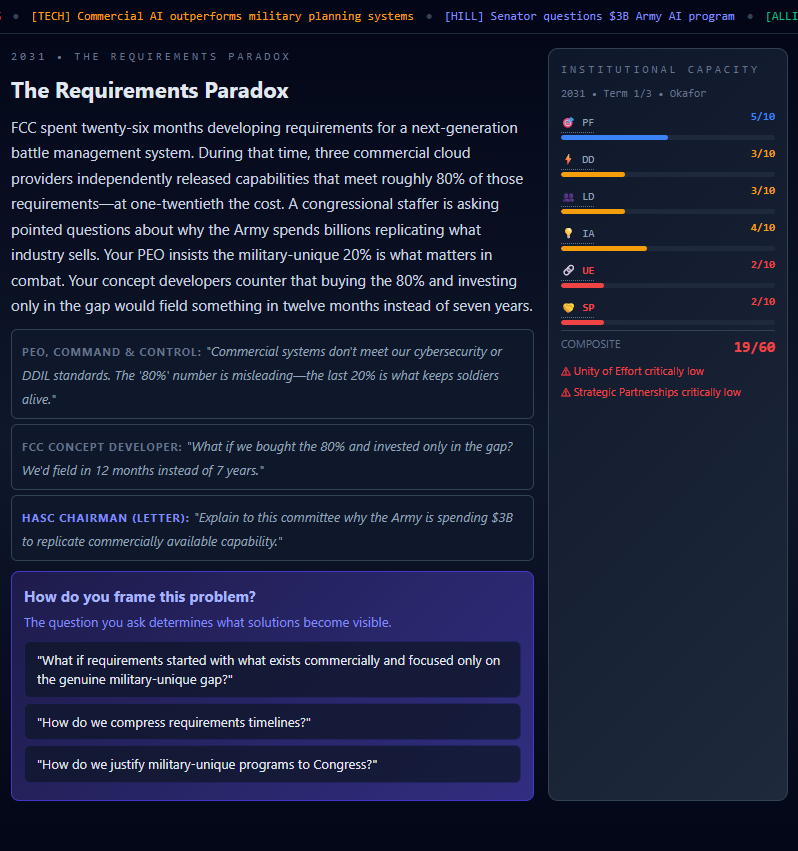
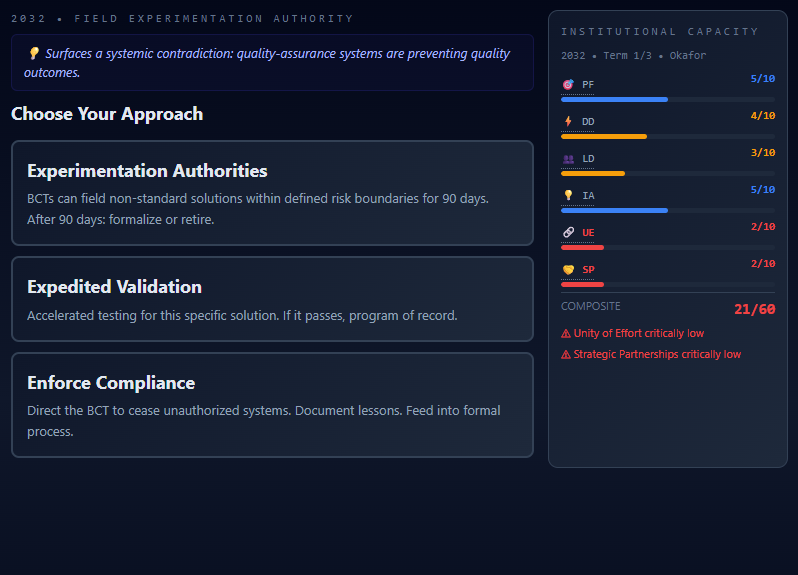
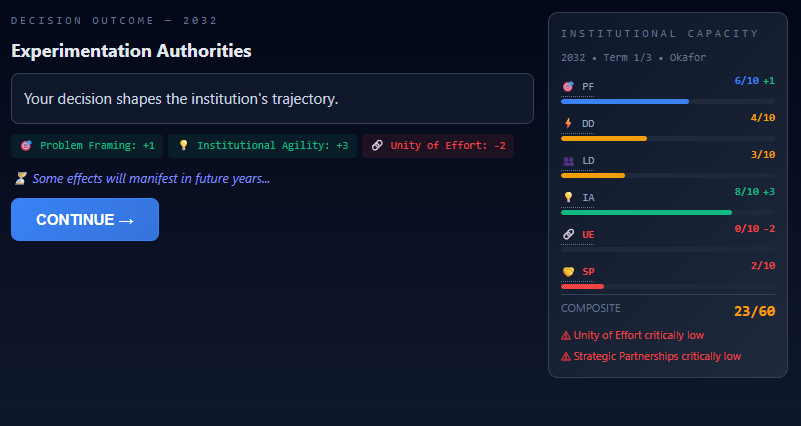
Moreover, the game aptly captures the fragility of military reform through its continuous “transition decay” engine. Every four years, a change of command occurs, which erodes the organization’s accumulated stats to simulate the loss of momentum when the player’s current leader choice departs. The underlying code reveals a hard strategic truth which is that technological dominance can be temporary, but culture is usually enduring. If a player fails to invest heavily in the “Leader Development” metric prior to a transition, their capabilities and metrics can rapidly decrease.
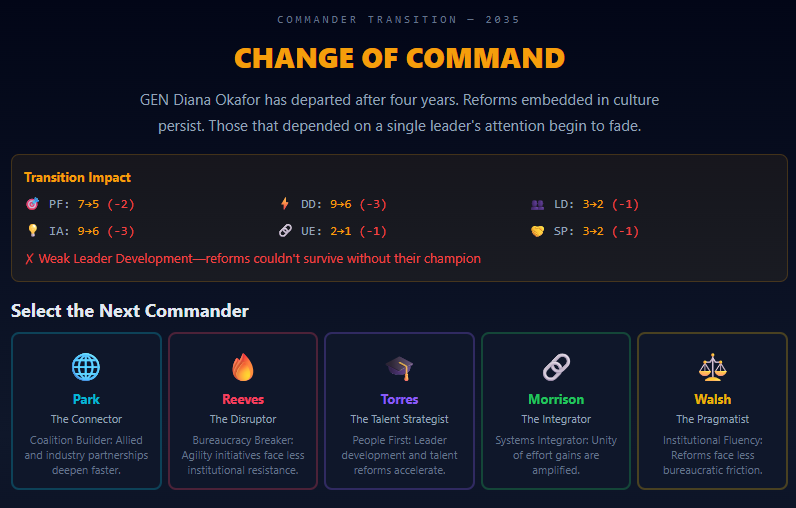
The game also highlights the inevitable tradeoffs required in force design and acquisition, punishing isolated strategies. The mechanics dictate that high performance in one area amplifies others, but critical failures cascade across the institution. For instance, a low “Decision Dominance” score does not just mean the staff is slow; it acts as a mathematical dampener that amplifies the damage suffered during randomized events like an “Electronic Warfare Blackout” or a “Congressional Investigation.” It models that the real enemy can be the “Budget Cut” in addition to the “Adversary Drone Swarm.” The internal bureaucratic fight can be just as lethal as a shooting war. The game forces leaders to realize that maintaining “Strategic Partnerships” with industry and allies is not merely a diplomatic nicety, but a required prerequisite for unlocking rapid commercial capabilities when traditional military acquisition/procurement programs inevitably take too much time or become too costly.

Vision to Victory is a conceptual model that can serve as a highly effective professional military education tool. It completely divests from the traditional wargaming focus on kinetic, battlefield overmatch, instead proposing that institutional capacity to learn and adapt is a critical advantage for the military.
 If you enjoyed this post, check out the T2COM G-2’s Operational Environment Enterprise web page, brimming with authoritative information on the Operational Environment and how our adversaries fight.
About the Author: Kristan J. Wheaton is the Professor of Strategic Futures at the US Army War College, Carlisle Barracks, Pennsylvania, where he teaches the Futures Seminar and the Innovation Champions Course. Wheaton is also the author of the Sources and Methods blog, several books, including The Warning Solution: Intelligent Analysis in the Age of Information Overload (AFCEA International, 2001) and Wikis and Intelligence Analysis (MCIIS Press, 2012), and has supervised more than 150 strategic futures projects for various organizations and companies, including senior Army leaders, US national intelligence agencies, and Fortune 500 firms.
Disclaimer: The views expressed in this blog post do not necessarily reflect those of the U.S. Department of War, Department of the Army, or the U.S. Army Transformation and Training Command (T2COM).


Thanks for the kind words in the write-up! Thanks also for sponsoring the contest! It was a blast to do!
Kris
Kristan, an outstanding product. While I may serve in a different countries military it is reassuring (and terrifying) that there is similarities in our issues that we deal with IRT cultural dinosaurs and real time adaptive decision making . I have used your VTV Strategic Game as a PME option for some Junior Officers I work with. Their confidence was bruised which was good. Are you going to continue developing this as a second generation training capability?