[Editor’s Note: The Army Mad Scientist Initiative is excited to feature Dr. Jonathan Tyrell again, with a piece focused on the Chaplain Corps! In his writing, Dr. Tyrell makes the ethics argument for Chaplains to be involved with the implementation of emerging technologies on the battlefield, as a way of readying soldiers for the mental strain of future warfare. — Read on!]
We assess the future operating environment for its effects on lethality, speed, and survivability. We should also assess it for its effects on conscience.
That sounds like a welfare concern. It is not, or not only. The ethics of force, meaning the just war tradition, the law of armed conflict, and the soldier’s own sense of what he can live with, rests silently on four assumptions: that there is one shared timeline, that acts are irreversible, that agents are individuated and accountable, and that outcomes occur in a single shared space where they can be weighed. Emerging capabilities are eroding all four. The erosion is already underway in autonomy, human-machine teaming, and cognitive technologies, and an adversary can accelerate it on purpose. Moral cognition is therefore a contested surface in the cognitive domain, not only a matter of resilience. A futures enterprise that omits it risks fielding a force that wins and does not come home whole.
A blind spot in the human dimension
U.S. Army Transformation and Training Command exists to anticipate the next war and shape the force that will fight it. Its attention to the human dimension, meaning cohesion, resilience, performance, and decision-making, is now mature enough to be a real portfolio. But that portfolio mostly asks how the soldier performs and endures. It rarely asks whether the soldier remains, through and after the act of war, an integrated moral agent.
Those are different questions. Performance and resilience treat the soldier as a system to be optimized and hardened. Moral cognition treats the soldier as a conscience that must act, account for the act, and live with it. The second question is the one most exposed by the technologies we are building, and it is the one we are not asking.
The four quiet assumptions
Every serious account of when and how force may rightly be used rests on a substrate so familiar we never state it. Four assumptions hold it up.
First, a shared timeline. The belligerent, the victim, the commander, and the judge all inhabit one sequence of events, where provocation precedes response and cause precedes effect. Deterrence, attribution, and accountability all require it.
Second, irreversibility. What is done cannot be undone. The dead stay dead, the city stays burned. The entire moral weight of using force comes from the finality of force. 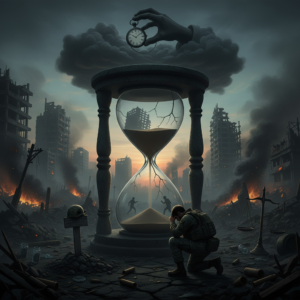
Third, individuated, accountable agents. The law of armed conflict is built on persons: a combatant distinct from a noncombatant, an operator who acts and returns to give an account, a commander in whom responsibility vests. Distinction, proportionality, and command responsibility are unintelligible without locatable agents.
Fourth, a finite, shared outcome-space. The weighing of lesser evils assumes outcomes occur in one place where they can be summed and compared. Harm reduced here is harm reduced, full stop.
These four run so deep that we mistake them for the structure of reality rather than the structure of our ethics. Each is now being drawn down.
Where the assumptions are already fraying
None of this is hypothetical. The erosion is in the current portfolio.
Autonomy and machine-speed targeting strain the accountable agent. When a lethal decision is distributed across a sensor, an algorithm, a policy threshold, and a human approving at a tempo no human can truly adjudicate, the agent in whom responsibility vests becomes harder to name. Not absent, but diffused, and diffusion is the first stage of corrosion.
Human-machine teaming pushes agency further, into a hybrid whose decisions belong wholly to neither member. We are building systems of genuinely shared moral authorship, and our accountability doctrine has no settled language for it.
Cognitive and neural technologies touch the integrated self, the continuous agent who acts and then lives with having acted. Enhancement, pharmacological modulation of fear or memory, and the prospect of editing the affective residue of combat all promise performance and relief. They also quietly propose to sever the soldier from the moral weight of the deed. Relief from injury is mercy. Engineered insulation from the act is something else, and telling the two apart is exactly what a chaplain is trained to do.
The information environment erodes the shared timeline of fact: not the metaphysics of time, but the common sequence of agreed events on which attribution depends. When provocation and response can no longer be commonly sequenced, deterrence frays at the root. And an adversary who tells our soldiers that nothing they did was real, or final, or theirs to own, is not merely shaping perception. He is attacking the moral cognition on which cohesion and will depend. That is the clearest sign this surface is contested, and must be defended, not only cared for.
Each of these is a partial erosion of one assumption. To see what total erosion would look like, and how much we were relying on these assumptions all along, it helps to look at a limit case.
The deepest assumption is irreversibility
One of the four is load-bearing for the rest, and it is the one a chaplain reaches for first.
Strip away the shared timeline and you still have agents acting irreversibly within their own. Strip away the finite outcome-space and the finality of the act in the agent’s own history still grounds its weight. But strip away irreversibility itself. Let the soldier believe, in the moment of the act, that nothing is finally done, that there is always an adjacent branch, a reset, a version where this did not happen, and the moral seriousness of the act evaporates at its source. Reversibility is the solvent of conscience.
This matters because the illusion of reversibility is already available, already corrosive, and the future operating environment will make it more available, not less. A force that tells itself its acts can be edited, undone, or absorbed by a machine that really decided is rehearsing the precise belief that makes both recklessness in the act and devastation afterward more likely.
Here is the hinge, and it is the chaplain’s professional knowledge: moral injury is the wound of the irreversible. It is not fear, and it is not the body’s exhaustion. It is the response to having done, witnessed, or failed to prevent what cannot be taken back and what violates deeply held conviction. The wound exists because the act was final. So a soldier who acts under the anesthetic of reversibility does not escape moral injury. He defers it, and meets it later, intensified, when the lie breaks against the fact that the dead are still dead.
The honest anthropology refuses the cheap grace. It tells the soldier the truth, that the deed is final, holds him accountable as a real agent in a real history, and on that truthful ground makes integration possible: grief, accountability, meaning, and where the tradition allows it, forgiveness. Hannah Arendt named this in secular terms. Irreversibility is one of the two great predicaments of action, and the faculty that answers to it is forgiveness. What cannot be undone can still be forgiven, but only once it is owned as done. You cannot integrate, and cannot forgive, what you have been told never really happened. A theory that denies reversibility, read rightly, is not bleak. It is the precondition of healing.
Chronos, kairos, and the decisive moment
The classical tradition gave two words for time. Chronos is measured, sequential time: the clock time of operations, the timeline, the synchronization matrix. Kairos is the decisive, weighted moment, the charged instant on which everything turns. Military doctrine is in effect a discipline of chronos that exists to seize kairos: the decisive point, the culminating point, the initiative.
But the older meaning of kairos, the one the chaplain carries, is that the decisive moment is received rather than seized, that the weighted instant is precisely the one not finally at human disposal. The soldier lives in that tension. He is trained to seize the decisive moment and is answerable, before his own conscience and beliefs, for what he does in a moment whose full weight he did not author and cannot revoke. The chaplain, of all the proponents on the staff, is positioned to keep that distinction alive: to insist that the decisive moment is also a moral moment, and that a force which masters the seizing of kairos must still answer for what it seizes.
The recommendation: the chaplain as proponent for moral cognition
The practical claim follows directly. The Chaplain Corps should be repositioned, within futures analysis, from a caregiver who treats the wounded conscience after the fact to a proponent who is present when the conditions of conscience are being designed. Four moves, routed through the command’s own functions of concepts, experimentation, requirements, and integration.
Write moral cognition into concept development.
Add to the human-dimension line of every emerging concept an explicit question: how does this capability change the soldier’s standing as an accountable, integrated moral agent, not merely whether it stresses him? The question is cheap in the concept and ruinous in the after-action review.
Seat religious-support and ethics expertise in experimentation and wargaming.
Put chaplain and ethics voices into concept development, useful-fiction work, and futures wargame design, so the moral effects of a capability surface while it is still a hypothesis to be tested, not a fielded system to be explained.
Adopt epistemic tiering as a discipline.
Tag speculative claims by how much weight they can bear, so moral and futures analysis can reach the far edge without being dismissed as soft and without laundering speculation into forecast. Discipline about what we know is what earns the moral argument a hearing in a hard room.
Treat irreversibility-integration as a design consideration.
Recognize moral injury not only as a condition treated downstream but as a hazard to design against in the requirement. Where a capability’s principal moral effect is to insulate the soldier from the finality of his acts, name and weigh that as a cost, rather than banking it silently as a benefit.
Coming home whole
A force that cannot integrate what it has done degrades, in cohesion and in conscience, over exactly the timescales the command exists to anticipate. The ethics of force has always rested on a quiet picture of time, finality, agency, and outcome. The future operating environment is the first in our history with the power to alter that picture rather than merely test it. The chaplain has been standing at the seam of chronos and kairos, of the act and its integration, the whole time. The recommendation here is simply to bring that proponent to the table while the future is still being designed: before the decisive moment, not after it.
 If you enjoyed this post, check out the T2COM G-2’s Operational Environment Enterprise web page, brimming with authoritative information on the Operational Environment and how our adversaries fight.
About the Author: Jonathan Tyrrell is a U.S. Army Reservist, Ordained Minister, former history teacher and strategic foresight analyst whose work spans military ethics, AI governance, and nuclear command authority. He holds degrees from Drew University, the London School of Economics, Princeton Theological Seminary and Liberty University. He is currently completing post graduate research at the University of Edinburgh on the intersection of Science, Philosophy and Religion.
Disclaimer: The views expressed in this blog post do not necessarily reflect those of the U.S. Department of Defense, Department of the Army, or the Transformation and Training Command (T2COM).
Sources and Further Reading
The argument draws on the just war tradition (Augustine, Aquinas, and Walzer’s Just and Unjust Wars); on the moral injury literature (Jonathan Shay’s Achilles in Vietnam and Odysseus in America, and the work of Brett Litz and colleagues), with the framing of moral injury as the wound of the irreversible being the author’s emphasis; on Hannah Arendt’s The Human Condition for irreversibility and forgiveness; on Derek Parfit’s Reasons and Persons for fission and personal identity; and on the classical and New Testament usage of chronos and kairos. The limit-case physics is developed and tiered in the companion paper.