[Editor’s Note: The Army Mad Scientist Initiative has an enduring tradition of hosting William & Mary undergraduate students as embedded interns. These interns are put to work on Day 1 of their internship, directly engaging in Mad Scientist endeavors to expand the U.S. Army’s understanding of the Operational Environment. Our interns author Mad Scientist Laboratory blog posts, support production of The Convergence podcasts, help facilitate Mad  Scientist conferences and document key findings in final reports, serve as judges in scoring Mad Scientist contest submissions, and enter open- source Operational Environment (OE) insights — just to name a few key mission requirements they support. Several interns have gone on to accept consulting positions as contractors and even Department of the Army civilian positions within the initiative, while others have gone on to support our Sister Service intelligence efforts and the wider Intelligence Community.
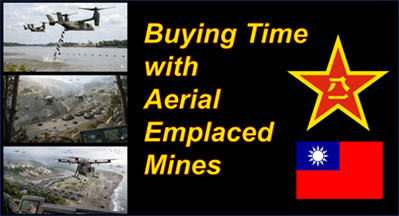
Today’s guest post submission is by Kunal Chauhan — our current Mad Scientist William & Mary intern — who explores the thorny challenge of time associated with any potential Chinese People’s Liberation Army (PLA) assault on Taiwan. Kunal proposes to buy more vital time for Taiwan’s beleaguered defenses by harnessing the precision and mass of aerial-delivered sea and land mines to slow any PLA onslaught. These proposed multi-dimensional mine fields — rapidly emplaced by air to interdict and deny access to vital PLA Sea and Ground Lines of Communication (SLOCs / GLOCs) — could buy valiant Taiwanese defenders enough time to mobilize, maneuver to, and engage with PLA Army forces as they attempt to land and seize key beachheads, break out of their lodgment areas, and capture key Taiwanese objectives — Read on!]
Scenario: Taiwan Strait, 2027

President Xi Jinping of the People’s Republic of China orders a surprise invasion across the Taiwan Strait. Hundreds of thousands of People’s Liberation Army (PLA) soldiers and hundreds of PLA Navy (PLAN), Chinese Coast Guard (CCG), Maritime Militia, and commercial vessels supporting the operation surge across the strait. The Taiwanese leadership, which has invested in minelaying vessels, orders the rapid deployment of its counter-landing forces, only to be informed that preemptive PLA air and naval strikes have destroyed much of this capability — severely diminishing Taiwan’s porcupine strategy and giving less time for its Combined Arms Brigades to mobilize, surge to, and engage the PLA on the beaches.1 Any Taiwanese  minelayers still afloat are easy targets for strikes by the PLA Air Force (PLAAF), handing uncontested naval control to China, accelerating their invasion.
In any scenario involving an amphibious assault on Taiwan, the PLAN needs uncontested control of the Taiwan Strait, and the PLA needs to be able to secure beachheads. Taiwan’s biggest enemy here is time; in terms of how much it needs to mobilize its reserves and the time it needs for potential allied reinforcement, especially if China can implement any version of area denial around the island. What’s needed is a cost-effective, battle-tested way to buy time: minefields. Taiwan is already investing in new minelaying vessels and training for its navy. However, any Taiwanese minelaying vessel will be a priority target in an initial PLA strike. The US, in its efforts to either reinforce Taiwan or support its defense will face the same issue of time and the same vulnerabilities, especially as China lays sea mines of its own around the island. While there is no silver bullet, there is a capability that Taiwan, the US, and its allies could employ– aerial minelaying (in both the Sea and Land Domains), from both manned fixed-wing and unmanned systems.
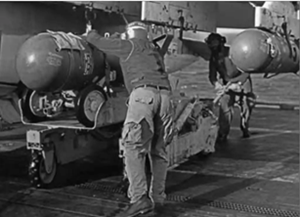
During the Second World War, aerial mine laying was an essential strategy for the Allies to achieve victory by being able to shut down the trade routes and mobility of the Axis powers. The U.S. Army Air Forces conducted these operations against Japan in the Pacific Theater of Operations (PTO), halting maritime traffic to the Japanese homeland.2 Mining of enemy waterways in both the PTO and the European Theater of Operations (ETO) hampered our adversaries’ resupply and reinforcement efforts, making the job of Allied ground forces easier.3 In Vietnam, U.S. aerial mining operations off North Vietnamese ports hampered Soviet sea-based supply and shut down Haiphong — their main port — for a little under a year.4
Aerial delivery of landmines in contemporary operations has also proven to be a cost-effective way of deterring enemy maneuver in the Land Domain — creating choke points and countering enemy advantages in mass, especially in Ukraine. New technologies like mine-carrying drones can rapidly emplace mines along vital main supply routes and potential axes of advance — denying adversaries maneuver space and channelizing their forces into kill zones, while saving manpower in the process. In the current Operational Environment, mining is more necessary than ever, especially in countering enemy advantages in time, proximity, and mass — considering the US may be forced to fight halfway around the globe, in an adversary’s backyard. From the Taiwan Strait to battles on land, delivering mines by air may become more prevalent, considering the vulnerability of manned mine-laying ships or terrestrial vehicles.
 How can aerial mining benefit troops on the ground and counter China’s proximity/mass advantage in Large Scale Combat Operations (LSCO)? The tyranny of distance may create a logistical nightmare, and projecting logistics requires time, especially in a robust Anti-Access / Area Denial (A2/AD) environment. Advances in minelaying could (at least temporarily) deny terrain to advancing PLA forces, buying time for Taiwan to mobilize its military and assemble them to engage PLA forces on advantageous terrain and for U.S. ground reinforcing efforts to be successful. The PLAN may be forced to clear these hastily emplaced minefields — a time-consuming process. If PLA troops are already on Taiwan, aerial mining could hamper the sustainment of ground operations, delaying vital resupply and reinforcement, while enabling Taiwan to assemble, vector, and mass forces to hold defensive lines. Even if mines are laid sparsely in the strait or on the beaches, the PLA will face increased attrition, which could jeopardize their operational capacity as they try to quickly advance inland.
There are a number of current technologies and concepts that could buy Taiwan time. One of these is the Quickstrike ER, which does the same job as a Joint Direct Attack Munition (JDAM), but with a naval mine. It can be launched from fixed wing aircraft (e.g., B1-B or F-18) around 40 nautical miles from a target zone, then glide to its target.5 Even if the system is shot down before reaching its intended coordinates, its payload likely will survive and remain a threat, albeit short of the zone for which it was intended. It can be launched immediately in the case of conflict and presents an immediate threat to any amphibious assault. This is an innovation in the conventional way to deliver naval mines from the air — aircraft flying low and slow to drop them into the water, making them easy targets for anti-aircraft fire. Another concept is the delivery of sea mines by Unmanned Aerial Systems (UAS).6 Currently there are a number of unmanned fighter and bomber aircraft in development, many of which can likely be modified to carry and deliver naval mines.7
Land Domain aerial mining can prevent adversaries from establishing secure beachheads. Technologies with this capability are already in use in the Russia-Ukraine war, with drone operators on both sides utilizing UAS to drop or emplace landmines along supply routes and at potential points of contact, targeting personnel and armored vehicles.8 Emplacing these mines precisely, along choke points, makes them far more effective in denying maneuver and reinforcement/resupply than scatter mining tactics, where artillery systems launch large, yet imprecise minefields.9 Employing this technology can threaten the logistics of any ground troops attempting to secure or break out of a beachhead, buying more time for US and allies to make it to the conflict  zone and respond to China’s aggression. These aerial-emplaced mines can also be used to create pre-planned kill zones — channelizing PLA troops and armored vehicles in an area for subsequent destruction by artillery fires and UAV/Loitering Munition (LM) swarms or saturation fires. These drone delivery systems are scalable, enabling the quick and easy conversion of dual-use civilian drones for combat purposes — especially as companies attempt to create drone delivery systems for consumer use which can operate with increasing range and weight.
Potentially investing in this capability also has far-reaching advantages for U.S. ground forces. The Army may benefit by increasing training for drone operators on aerial minelaying techniques, increasing our operational capacity.10 Beyond the Pacific, the Army could employ this capability in future conflicts against other near-peer adversaries like Russia or irregular threats, disrupting enemy supply lines and logistics. Furthermore, Army Aviation could 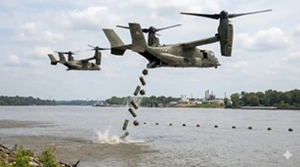 train in waterway mining and explore how rotary wing aircraft could be employed to drop both land and sea mines. Further advantages could emerge by collaborating with commercial drone manufacturers as well, exploring ways to rapidly scale up production of cargo drones, in the event of LSCO. These technologies, in conjunction with current investment into Unmanned Undersea Vehicles (UUV) and other sea-based minelaying, can allow increased denial capacity for the U.S. Joint Force, buying valuable time for troops to deploy into remote theaters, while also providing the capability to mine precisely in a contested environment. Aerial mining can also create naval and land chokepoints for targeted denial of maneuver space, hemming in enemy naval and ground assets.11 Aerial mining provides the US with another credible measure of deterrence against Chinese aggression, creating another potential challenge for their leadership to consider, especially given that US has done this on a large scale before. There are still some questions to consider though. How should the Army collaborate with our other Services on this capability? What drones, mines and aircraft should the Army use and/or procure for this purpose? And in the case of conflict, how can the Army work with industry to successfully scale production of these technologies fast?
 If you enjoyed this post, check out the T2COM G-2‘s Operational Environment Enterprise web page, brimming with authoritative information on the Operational Environment and how our adversaries fight, including:
Our T2COM OE Threat Assessment 1.0, The Operational Environment 2024-2034: Large-Scale Combat Operations
Our China Landing Zone, full of information regarding our pacing challenge, including ATP 7-100.3, Chinese Tactics, T2COM OE Threat Assessment 1-1, How China Fights in Large-Scale Combat Operations, T2COM OE Threat Assessment 1-1.1, How China Fights Against a U.S. Army Brigade Combat Team, 10 Things You Didn’t Know About the PLA, and BiteSize China weekly topics.
Our Russia Landing Zone, including T2COM OE Threat Assessment 1-2, How Russia Fights in Large-Scale Combat Operations and the BiteSize Russia weekly topics. If you have a CAC, you’ll be especially interested in reviewing our weekly RUS-UKR Conflict Running Estimates and associated Narratives, capturing what we learned about the contemporary Russian way of war in Ukraine in 2022 and 2023 and the ramifications for U.S. Army modernization across DOTMLPF-P.
Our Iran Landing Zone, including the Iran Quick Reference Guide and the Iran Passive Defense Manual (both require a CAC to access).
Our North Korea Landing Zone, including Resources for Studying North Korea, Instruments of Chinese Military Influence in North Korea, and Instruments of Russian Military Influence in North Korea.
Our Irregular Threats Landing Zone, including TC 7-100.3, Irregular Opposing Forces, and ATP 3-37.2, Antiterrorism (requires a CAC to access).
Our Running Estimates SharePoint site (also requires a CAC to access) — documenting what we’re learning about the evolving OE (including Russia’s war in Ukraine war since 2024 and other ongoing competitions and conflicts around the globe). Contains our monthly OE Running Estimates, associated Narratives, and the quarterly OE Assessment Intelligence Posts.
… as well a past Mad Scientist Laboratory blog posts and T2COM G-2 content exploring the force multiplier effects of battlefield automation:
Ukraine Conflict UAV Evolution, by Colin Christopher
Death From Above! The Evolution of sUAS Technology and associated podcast, with COL Bill Edwards (USA-Ret.)
Jomini’s Revenge: Mass Strikes Back! by proclaimed Mad Scientist Zachery Tyson Brown
Insights from the Robotics and Autonomy Series of Virtual Events and associated videos
On the Ground and In the Air in Ukraine, and associated podcast, with Wolfgang Hagarty
Asymmetric Warfare across Multiple Domains, by Ethan Sah
Unmanned Capabilities in Today’s Battlespace
Revolutionizing 21st Century Warfighting: UAVs and C-UAS
The PLA and UAVs – Automating the Battlefield and Enhancing Training
About the Author: Kunal Chauhan is currently serving as a T2COM G-2 intern, embedded with the Mad Scientist Initiative. He previously interned with the U.S. Army War College, Carlisle Barracks, Pennsylvania, where he researched Indian foreign policy history and interviewed former Indian military officials to help predict future Indian foreign policy. Mr. Kunal will graduate from William & Mary in May 2026 with a BA in International Relations and a minor in Economics.
Disclaimer: The views expressed in this blog post do not necessarily reflect those of the U.S. Department of War, Department of the Army, or the U.S. Army Transformation and Training Command (T2COM).
1 https://interestingengineering.com/innovation/china-decapitate-taiwan-porcupine-defense
2 https://www.anesi.com/ussbs01.htm
3 https://media.defense.gov/2017/Dec/28/2001861720/-1/-1/0/T_CHILSTROM_MINES-AWAY.PDF
4 https://www.gvva1.org/1972-05-08-Secret-Mining-of-Haiphong-Harbor-N-Vietnam.pdf
5 https://defensefeeds.com/analysis/weapons/quickstrike-er/
6 https://www.usni.org/magazines/proceedings/2025/july/how-unmanned-systems-could-bring-back-naval-aerial-mining
7 Ibid.
8 https://united24media.com/latest-news/russian-shahed-drones-now-scatter-anti-tank-mines-over-ukraine-10487
9https://www.forbes.com/sites/davidhambling/2025/04/03/mine-craft-ukrainian-drones-add-a-new-dimension-to-mine-warfare/
10 https://www.mca-marines.org/gazette/drone-delivered-minefields/
11 Ibid.