“We break the innovation cycle when we make our capabilities so modular, so cheap, and so decentralized that the enemy’s rapid cycles of counter-innovation have nothing to grip onto.“
[Editor’s Note: Army Mad Scientist launched its CALLING ALL CREATORS Multi-Media Contest on 10 December 2025 with the following Army Transformation Challenge:
Contemporary conflicts around the globe have demonstrated the ever-increasing speeds at which warfighting innovations are being fielded — granting a combatant decisive battlefield advantage — until effective  counter-measures are fielded by an adversary. These rapid cycles of innovation and counter-innovation currently provide only a few weeks (at best) of advantage.
How can the U.S. Army and Joint Force break this cycle and field robust and resilient capabilities that provide enduring battlefield advantage?
We are pleased to announce we received a total of 29 contest entries, running the gamut of multi-media — from haikus, illustrated poems, and riddles; images and posters; comics and graphic stories; a video, illustrated essays, Fictional Intelligence (FICINT) stories/scenarios, an interactive web experience, and even a strategic decision game! To everyone who took the time to consider our challenge, then craft and submit an entry, please accept a hearty Mad Scientist “Thank you!”
Today’s post by Rouge Studios was determined to be the contest’s second runner-up (“bronze”), as scored by our panel of T2COM G-2 judges against the following rubric:
R1. Does the submission address the Army Transformation Challenge writing prompt (identified above)?
R2. Does the author make a clear, coherent, and compelling case for why the topic is important to the Army?
R3. Did the submission explore this topic in a creative, novel, and innovative way?
R4. Is this submission “edgy” (i.e., does it broaden and expand our understanding of the Operational Environment in a new way)?
R5. Should the submission be featured as a blog post (i.e., is it “blog-worthy”) or publishable?
R6. Is this submission a contender for being selected as the contest’s winner (i.e., “the best of the best of the best”)?
In addition to their essay that included a FICINT vignette — “a conceptual deep-dive that defines the ‘Hubris Tax’ and explains how the Mosaic serves as a metaphor for a new geometry of warfare, one where the lack of a center makes the force impossible to kill;” Rouge Studios‘ submission also included a 60-second multi-media narrative — “a cinematic exploration of the transition from institutional hubris to the ‘Stray Dog’ mentality.” This video (accessed here) was produced using advanced AI-generative tools (Veo and ElevenLabs) “to visualize a future where authority is sharded and resilience is the primary weapon.” — Enjoy!]
I. EXECUTIVE SUMMARY
The contemporary cycle of innovation and counter-innovation is currently optimized for a war of attrition that the U.S. Army is positioned to lose. By continuing to invest in centralized, high-value platforms—”Monoliths”—the Joint Force provides adversaries with clear, high-payoff targets for asymmetric counters. This submission proposes the Stray Dog Protocol, a conceptual and cultural shift that replaces the Monolith with the Mosaic: a decentralized, hyper-resilient mesh of attritable capabilities. By moving from “Maximum Capability” to “Maximum Resilience,” and from “Empire” to “Survivor,” the Joint Force can achieve an enduring advantage that is financially, technically, and cognitively impossible for an adversary to overcome.
II. THE HUBRIS TAX: WHY THE OLD CYCLE FAILS
The innovation cycles observed in recent conflicts—where an advantage lasts mere weeks—are not a failure of technology, but a failure of philosophy. For decades, the American military-industrial complex has operated under the “Monolith Assumption”: that the most expensive, most integrated, and most centralized system is inherently the most effective.
We have spent trillions building monuments to our own technical superiority. These platforms—aircraft carriers, stealth bombers, complex satellite constellations—are masterpieces of engineering, but they are architecturally brittle. They are “Too Big to Fail,” which in modern warfare makes them “Too Expensive to Lose.”

Adversaries do not try to match our wealth; they optimize for our arrogance. They spend thousands to defeat billions. This is the Hubris Tax — the staggering cost of protecting centralized assets that are fundamentally incompatible with a high-threat, rapid-innovation environment. To break the cycle, we must stop paying the tax. We must stop building targets.

III. THE STRAY DOG MENTALITY: A CULTURAL PIVOT
The Mosaic was not conceived in a laboratory; it was born in a moment of radical institutional humility. To field truly resilient capabilities, the U.S. Army must first adopt a Stray Dog Mentality.
A stray dog does not rely on a supply chain. It does not have a home base to  be targeted. It assumes that the adversary is smarter, more patriotic, better funded, and more desperate. It treats every engagement as a fight for survival in a corner.
The Shift in Logic:
1. Assume Technical Parity: We must stop assuming our “Secret Sauce” will remain secret. Assume the enemy has already hacked the code.
2. Assume Financial Inferiority: We must build as if we are the ones being outspent. This forces the shift toward “attritable” mass rather than “exquisite” platforms.
3. Assume Total Visibility: In an era of perfect sensors, stealth is a temporary illusion. The only enduring defense is being too numerous and too distributed to be worth a missile.
IV. THE MOSAIC LOGIC: A CONCEPTUAL ARCHITECTURE FOR THE SWARM
The Mosaic is not a specific piece of hardware; it is a design metaphor for a force that has successfully decoupled capability from centralized authority. It represents a transition from “Platform-Centric Warfare” to “Functional Distribution.”
1. The “Cell” as a Unit of Action. In the Mosaic logic, we stop thinking in terms of “The Tank” or “The Satellite.” Instead, we think in Cells. A Cell is a metaphor for the smallest viable unit of military effect—be it a single code script, a lone scout, or an attritable sensor. By treating every element of the Joint Force as a “Cell” rather than part of a “Monolith,” we ensure that no single loss can paralyze the whole. We move from a military of “Vital Organs” to a military of “Stem Cells”—where every part is capable of regenerating the mission.
2. The Protocol of Decoupled Authority. The power of the Mosaic metaphor lies in the absence of a center. Traditional innovation focuses on protecting the “Brain” (i.e., Command and Control [C2]). The Mosaic
Logic assumes the “Brain” is an illusion. We propose a framework where authority is “sharded” across the entire mesh. Advantage is found when the lowest-level units (the “Stray Dogs”) are empowered to act on intent without waiting for a signal from a center that may no longer exist.
3. Resilience via Redundancy. The Mosaic represents a shift in how we value assets. In the old cycle, a loss was a tragedy; in the Mosaic Logic, a loss is merely data. By metaphorically “shattering” our capabilities into a swarm, we force the adversary to fight a ghost. They are optimized to kill “Systems.” They are not optimized to kill “Logic.” The enduring advantage is found in the realization that you can destroy the physical nodes of a swarm, but you cannot destroy the swarm intelligence that governs them.
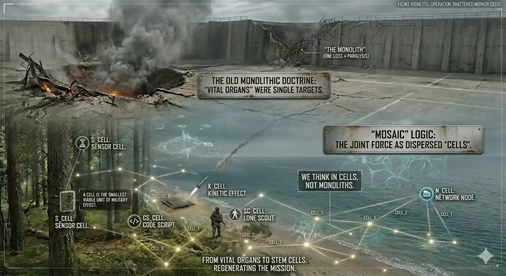
V. FICINT VIGNETTE: OPERATION SHATTERED MIRROR (2031)
The adversary’s “God-Killer” hypersonic battery was the pinnacle of their innovation cycle. It was designed to hit the center of our C2 node. And it did.
At 04:12 hours, the kinetic impact vaporized our primary command center. On the enemy’s screens, the red dot representing our authority disappeared. They assumed the battle was won.
The Reality: The command center they hit was a “Decoy Monolith”— a hollow shell designed to attract the Hubris Tax. The real C2 was already gone, dissolved into the Mosaic. Ten thousand Cells were scattered across the littoral forest and the seabed.
As the enemy moved to capitalize on their “victory,” the Mosaic activated. Not as a single unit, but as a thousand stings. A sensor Cell in a tree identified the enemy’s vector; a processing Cell a mile away calculated the firing solution; a kinetic Cell hidden in the sand launched the intercept.
The adversary spent three years and $400 million developing a missile to kill a building. We spent $12.00 in electricity to re-route a mesh network that didn’t even notice the building was gone.

That is the Enduring Advantage. We didn’t win because we were stronger. We won because we were impossible to find, and too small to kill.
VI. CONCLUSION: THE MINDSET IS THE WEAPON
The “Army Transformation Challenge” is not a call for better hardware; it is a call for a better way of being.
 Enduring advantage cannot be bought; it must be practiced. It requires the courage to set aside the “Empire” mindset and embrace the “Stray Dog” reality. We break the innovation cycle when we make our capabilities so modular, so cheap, and so decentralized that the enemy’s rapid cycles of counter-innovation have nothing to grip onto. The Mosaic is not just a weapon system. It is the physical proof that the U.S. Army has the humility to learn, the grit to survive, and the vision to win.
There is no center. There is only the swarm.
 If you enjoyed this post, check out the T2COM G-2‘s Operational Environment Enterprise web page, brimming with authoritative information on the Operational Environment and how our adversaries fight, including:
Our T2COM OE Threat Assessment 1.0, The Operational Environment 2024-2034: Large-Scale Combat Operations
Our China Landing Zone, full of information regarding our pacing challenge, including ATP 7-100.3, Chinese Tactics, T2COM OE Threat Assessment 1-1, How China Fights in Large-Scale Combat Operations, T2COM OE Threat Assessment 1-1.1, How China Fights Against a U.S. Army Brigade Combat Team, 10 Things You Didn’t Know About the PLA, and BiteSize China weekly topics.
Our Russia Landing Zone, including T2COM OE Threat Assessment 1-2, How Russia Fights in Large-Scale Combat Operations and the BiteSize Russia weekly topics. If you have a CAC, you’ll be especially interested in reviewing our weekly RUS-UKR Conflict Running Estimates and associated Narratives, capturing what we learned about the contemporary Russian way of war in Ukraine in 2022 and 2023 and the ramifications for U.S. Army modernization across DOTMLPF-P.
Our Iran Landing Zone, including the Iran Quick Reference Guide and the Iran Passive Defense Manual (both require a CAC to access).
Our North Korea Landing Zone, including Resources for Studying North Korea, Instruments of Chinese Military Influence in North Korea, and Instruments of Russian Military Influence in North Korea.
Our Irregular Threats Landing Zone, including TC 7-100.3, Irregular Opposing Forces, and ATP 3-37.2, Antiterrorism (requires a CAC to access).
Our Running Estimates SharePoint site (also requires a CAC to access) — documenting what we’re learning about the evolving OE (including Russia’s war in Ukraine war since 2024 and other ongoing competitions and conflicts around the globe). Contains our monthly OE Running Estimates, associated Narratives, and the quarterly OE Assessment Intelligence Posts.
… as well as previous Mad Scientist Laboratory content, exploring this aspect of the Operational Environment:
The New Rules of the Game: 10 Key Lessons on Great Power Competition
Expendable Drones: Appreciating the Evolving Technology – and Character – of War, by proclaimed Mad Scientist Dr. James Giordano, Elise Annett, and John Bitterman
Ukraine Conflict UAV Evolution, by Colin Christopher
Do Androids Dream of Electric War: The Reality of Autonomous Weapons and associated podcast, with Dr. Mark Bailey
On the Ground and In the Air in Ukraine and associated podcast, with Wolfgang Hagarty
Insights from Ukraine on the Operational Environment and the Changing Character of Warfare
Learning from LSCO: Applying Lessons to Irregular Conflict, by Ian Sullivan and Kate Kilgore
Asymmetric Warfare across Multiple Domains, by Ethan Sah
“Own the Night,” as well as Former Deputy Secretary of Defense and proclaimed Mad Scientist Mr. Bob Work‘s presentation from the Disruption and the Future Operational Environment Conference on AI and Future Warfare: The Rise of the Robots (and Army Futures Command), and his Modern War Institute podcast assessing the future battlefield.
Unmanned Capabilities in Today’s Battlespace
Revolutionizing 21st Century Warfighting: UAVs and C-UAS
Death From Above! The Evolution of sUAS Technology and associated podcast, with COL Bill Edwards (USA-Ret.)
The Operational Environment’s Increased Lethality
Top Attack: Lessons Learned from the Second Nagorno-Karabakh War and associated podcast, with proclaimed Mad Scientist COL John Antal (USA-Ret.)
Jomini’s Revenge: Mass Strikes Back! by proclaimed Mad Scientist Zachery Tyson Brown
Through Soldiers’ Eyes: The Future of Ground Combat and its associated podcast
The PLA and UAVs – Automating the Battlefield and Enhancing Training
A Chinese Perspective on Future Urban Unmanned Operations
China: “New Concepts” in Unmanned Combat and Cyber and Electronic Warfare
The PLA: Close Combat in the Information Age and the “Blade of Victory”
“Once More unto The Breach Dear Friends”: From English Longbows to Azerbaijani Drones, Army Modernization STILL Means More than Materiel, by Ian Sullivan
Insights from the Robotics and Autonomy Series of Virtual Events and associated video playlist
How Big of a Deal are Drone Swarms? by proclaimed Mad Scientist Zak Kallenborn
About the Authors:
Rouge Studios: Based in Los Angeles, Rouge Studios is a premier, full-service co-development powerhouse specializing in world-class performance capture, advanced 3D scanning, voice-over and sound design and high-fidelity environment building. Our team delivers AAA-quality digital avatars, props, and cinematic-ready worlds for Video Games, Film, and TV. Having recently expanded into the defense vertical, we provide final engine-ready delivery and systems integration, serving as a dedicated, innovative partner for the next generation of mission-critical training and simulation.
Jenna Melfi: Jenna Melfi is the CEO of Rouge Studios, where she leads a premier team in delivering AAA-quality visual storytelling and production services across global digital platforms. Committed to a culture of empowered collaboration and growth, she is focused on establishing Rouge as a dedicated, people-first partner for the next generation of defense innovation development.
Vince Argentine: Vince Argentine is the President and CTO of Rouge Studios, bringing over 20 years of experience leading technical teams on projects ranging from AAA video games to Marvel blockbuster films. He is dedicated to applying his world-class technical precision to the government sector, ensuring Rouge Studios serves as an innovative partner for advanced technology and visual solutions.
Disclaimer: The views expressed in this blog post do not necessarily reflect those of the U.S. Department of War, Department of the Army, or the U.S. Army Transformation and Training Command (T2COM).