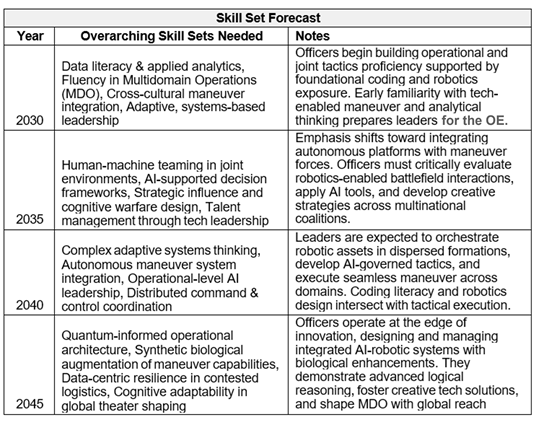
[Editor’s Note: Army Mad Scientist welcomes back guest blogger Dr. Jacob Barton with the second in his series of posts. Last week, he explored the evolving Operational Environment‘s trends and the associated challenges the Army faces in ensuring our Leaders are prepared and ready to win decisively, come what may. In today’s post, Dr. Barton proposes a number of reforms to ensure our rising cohorts of senior officers can sustain their talent overmatch, vice that of our adversaries. Dr. Barton describes the basic skill set requirements that these officers will require, by year — in 2030, 2035, 2040, and 2045 — and then outlines several strategic officer program recommendations. Finally, he illustrates these recommendations with six future LinkedIn profiles of successful Generation Z Army Leaders from the mid-2040’s — each benefiting from his proposed reforms. Enjoy!]
Future Operational Environment Basic Skill Set Requirements
Strategic Officer Program Recommendations
1. Career Flexibility Framework
a. Enable officers to rotate between operational, technical, and strategic assignments without penalty.
b.  Create hybrid tracks for all officers (e.g. Infantry–Strategist, AG–Cyber, FA–Acquisition) with tailored Professional Military Education (PME) and evaluation criteria.
c. Create rotational models that require officers to move between operational and technical tracks
d. Replace rigid Key Developmental (KD) assignments with target Knowledge, Skills, and Abilities (KSAs) gained through a variety or combination of operational and technical assignments. Redefine officer broadening assignments as technical in nature.
2. Senior Leader Talent Stewardship
a. 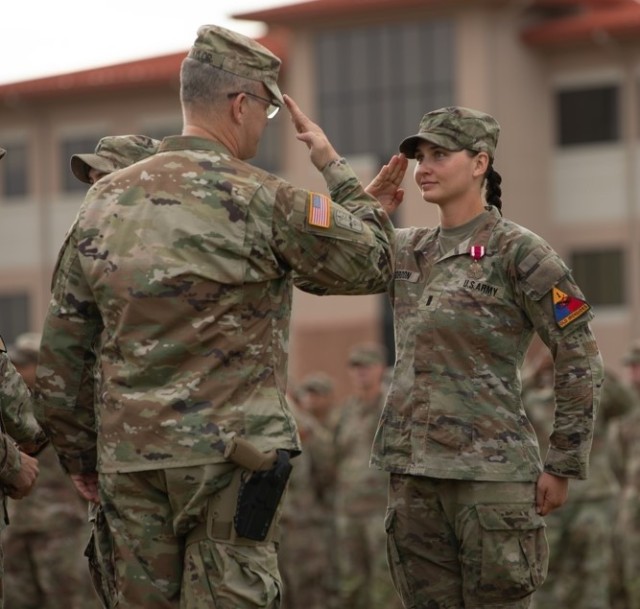 Rebalance the Army Talent Alignment Process (ATAP) with deliberate senior leader influence for key assignments.
b. Establish “Strategic Talent Boards” to identify and guide high-potential officers across domains.
c. Expand assessment tools (e.g., the Army’s Project Athena and Command Assessment Program [CAP]) to identify cognitive agility and tech aptitude.
3. Functional Area and Branch Reform
a. Consolidate or sunset Functional Areas (FAs) or branches that no longer require standalone career management.
b, Reclassify certain FAs as “skill identifiers” or “competency modules”
accessible to any officer.
c.  Preserve select high-tech FAs that require dedicated career management, while ensuring transfer decisions into these areas are governed by elevated authority to protect and optimize critical talent.
d. Authorize the HQDA DCS G-1, acting as the Army’s Chief Talent Officer, to strategically determine where officers with highly specialized technical skills could best be utilized to ensure the interests of the Army are paramount over any branch, FA, or proponent interests.
4. Future-Focused PME
a.  Integrate Artificial Intelligence (AI) ethics, quantum-informed operations, and synthetic biology into Officer Intermediate Level Education (ILE) / School of Advanced Military Studies (SAMS) curricula.
b. Expand immersive training (Augmented Reality / Virtual Reality [AR/VR]) for Operational Environment simulation and decision-making.
Reform End State
Dr. Barton concludes these insightful recommendations by positing six future LinkedIn profiles of successful Generation Z Army Leaders in the mid-2040’s — each benefiting from his proposed reforms:
LTC Joseph Gupta
MG Dana Lee
MAJ (P) Fox Brandreth Conner
COL Hugh R. Nelson
LTC Elijah Virelance
COL Crimson Novahelm
Check out each of these individuals’ LinkedIn profiles here — including their respective About statements, Experience positions, and Education — to see how Dr. Barton’s proposed reforms could shape Army Leadership to meet the evolving OE challenges of the 2040s!
 If you enjoyed this post, check out the T2COM G-2‘s Operational Environment Enterprise web page, brimming with authoritative information on the Operational Environment and how our adversaries fight, including:
Our T2COM OE Threat Assessment 1.0, The Operational Environment 2024-2034: Large-Scale Combat Operations
Our China Landing Zone, full of information regarding our pacing challenge, including ATP 7-100.3, Chinese Tactics, T2COM OE Threat Assessment 1-1, How China Fights in Large-Scale Combat Operations, T2COM OE Threat Assessment 1-1.1, How China Fights Against a U.S. Army Brigade Combat Team, 10 Things You Didn’t Know About the PLA, and BiteSize China weekly topics.
Our Russia Landing Zone, including T2COM OE Threat Assessment 1-2, How Russia Fights in Large-Scale Combat Operations and the BiteSize Russia weekly topics. If you have a CAC, you’ll be especially interested in reviewing our weekly RUS-UKR Conflict Running Estimates and associated Narratives, capturing what we learned about the contemporary Russian way of war in Ukraine in 2022 and 2023 and the ramifications for U.S. Army modernization across DOTMLPF-P.
Our Iran Landing Zone, including the Iran Quick Reference Guide and the Iran Passive Defense Manual (both require a CAC to access).
Our North Korea Landing Zone, including Resources for Studying North Korea, Instruments of Chinese Military Influence in North Korea, and Instruments of Russian Military Influence in North Korea.
Our Irregular Threats Landing Zone, including TC 7-100.3, Irregular Opposing Forces, and ATP 3-37.2, Antiterrorism (requires a CAC to access).
Our Running Estimates SharePoint site (also requires a CAC to access) — documenting what we’re learning about the evolving OE (including Russia’s war in Ukraine war since 2024 and other ongoing competitions and conflicts around the globe). Contains our monthly OE Running Estimates, associated Narratives, and the quarterly OE Assessment Intelligence Posts.
… as well as our previous Mad Scientist Laboratory content — exploring the future of U.S. Army talent management and the skill sets required to successfully engage our adversaries in a rapidly evolving OE:
What Skill Sets Will Leaders Need for Warfare in 2035? by the United States Army War College (USAWC) Team Techno-Warfare Group
2nd Dense Urban Armored Brigade (DUAB) Personnel Evaluations, by Ed dos Santos, Jr.
The Future of Talent and Soldiers with MAJ Delaney Brown, CPT Jay Long, and 1LT Richard Kuzma and associated podcast
Fight Club Prepares Lt Col Maddie Novák for Cross-Dimension Manoeuvre, by then LTC Arnel David, U.S. Army, and Major Aaron Moore, British Army, along with their interview in UK Fight Club – Gaming the Future Army and associated podcast
Imagining the Future Fight through Emerging Technology and associated podcast, with proclaimed Mad Scientist Jenny McArdle, Cmdr. Paul Grøstad, and Whitney McNamara
Going on the Offensive in the Fight for the Future and Strategic Latency Unleashed!
Setting the Army for the Future (Parts II and III)
New Skills Required to Compete & Win in the Future Operational Environment
About the Author: Dr. Jacob Barton is a national security and defense technology executive bridging battlefield reality and strategic transformation. Operating at the nexus of government, industry, and defense innovation, his experience spans special operations, congressional defense policy, and large-scale modernization — driving advances in AI, autonomy, command and control, and decision advantage. He currently serves as the Director of Intelligence Delivery & Integration at T2COM G-2.
Disclaimer: The views expressed in this blog post do not necessarily reflect those of the U.S. Department of War, Department of the Army, or the U.S. Army Transformation and Training Command (T2COM).