[Editor’s Note: Today’s guest submission is by Captain Anthony J. Kniffin, Commander of the 77th Combat Engineer Company-Infantry, U.S. Army. In this post, he chronicles the risks of an AI enabled malicious cyber campaign to Critical National Infrastructure (CNI). The post begins with a quick vignette to describe a scenario where this kind of campaign hampers the U.S. military’s readiness through sabotage. — Read on!]
The Ripple Effect: A Modern Vulnerability Vignette
Mike traced the lines of the control panel with a calloused finger. For thirty years, he had overseen the southeastern power grid from one of its many regional hubs. Today, he sensed, would be a busy day. Small towns in North Carolina were inexplicably drawing power like miniature cities. A relay in Raleigh cycled erratically. A transformer near Charlotte failed to shed its load as it should. Individually, these were minor issues. Collectively, they formed a tightening knot of unease.
“Something’s overburdening the system,” he muttered, his voice raspy. He punched a sequence into the console, running a predictive analysis. The results flashed red. “Impending outage. Sector 4, likely within the hour,” he relayed to dispatch. “We’re walking a tightrope here, folks. Something’s pulling too much juice, and I can’t pinpoint the source”.
Thirty miles away, at Stellaris Computer Corps’ sprawling manufacturing facility in Research Triangle Park, the lights flickered, then died. The factory floor, a ballet of robotic precision moments before, froze. In the shipping department, usually a hub of bustling activity, products sat on halted conveyor belts.

“Now what?” thought Arthur Pullman, Stellaris’s Regional Distribution Manager. He paced, agitated, knowing this delay would surely be blamed on him. It wasn’t his job to keep the lights on; it was his job to get products out the door. He slammed his fist on his desk. “What atrocious timing,” Arthur thought, acutely aware they were already behind on orders.
The outage lasted just under three hours. Stellaris’s automated systems recalibrated, and the assembly and shipping lines shuddered back to life. Operations resumed, but the damage was done, and the backlog was sizeable. Customers were already flooding the customer service lines with complaints: “Where’s my order? I paid for next-day shipping!”. Preoccupied with brand reputation, Stellaris executives made a swift decision: prioritize fulfilling consumer orders to make up for the delay and offer discounts to keep customers happy. This, however, meant pushing back fulfillment on their government contracts, possibly for a few weeks.
A few weeks later, Mike was monitoring Sector 4 again when a different anomaly occurred. Not an outage, but a spike. Sector 4 was becoming a persistent problem, though Mike was thankful for the 85% efficiency his section maintained, recalling reports of efficiency rates at 58% with multiple faults per day in other sections. Mike returned to the console, certain the spike would trip breakers or cause some fluctuation, but nothing catastrophic, no fires, no blown transformers arcing sparks.
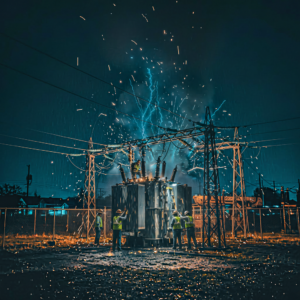
Unbeknownst to Mike, the spike had scrambled the electronic logging devices at Global-World Shipping Company. One of their trucks, driven by a contractor named Earl Jenkins, was carrying a government shipment of Stellaris products destined for Virginia. Earl’s hours hadn’t been properly recorded, triggering a mandatory rest period that further delayed his delivery.
What neither Mike, nor Arthur, nor Earl knew was the true significance of these compounding delays. One of the Stellaris products on Earl’s truck was a replacement circuit board. It wasn’t destined for backstock or a corporate computer server. It was a replacement CPU message relay for the RPM display in the engine room of the USS Vicksburg (CG 69), a Ticonderoga-class guided-missile destroyer scheduled for a major naval exercise. The Vicksburg sat in Norfolk Naval Station, awaiting the part. It wasn’t a critical failure; the ship could still operate, but the exercise required precise engine performance monitoring. Without a functioning RPM display, the Navy couldn’t risk deploying the vessel and damaging one or more of its engines. The exercise date came and went. The Vicksburg remained in port.
The delay wasn’t malicious, wasn’t sabotage. It was a ripple effect, born from a subtle strain on the power grid, a minor outage, and a slight spike. These were compounded by a prioritization of consumer orders, a scrambled administrative program, and a seemingly insignificant circuit board. But nonetheless, the Navy was down one ship, and somewhere, in a darkened room, someone or something was quietly reassessing the balance of power.
The Burden Strategy: A “New” Dimension of Warfare
The past two decades have seen conflict evolve, with cyber capabilities adding speed, anonymity, and widespread disruption to traditional warfare. This digital front enables a return to an antiquated yet devastating approach: a strategy of gradual, systemic pressure. Imagine an AI-driven campaign designed to subtly burden critical infrastructure, thus disarming a nation’s ability to resist. The convergence of AI with infrastructural vulnerabilities creates a new battlefield, disrupting great power dominance through asymmetric warfare.

Clausewitz’s On War (1832) laid the foundation for modern military theory, concepts later distilled into the nine principles of war by J.F.C. Fuller in 1926. These enduring principles, still relevant in today’s military doctrine, can be re-examined and reimagined for a new era. This “burden strategy” directly echoes Clausewitz’s emphasis on disrupting an enemy’s ability to wage war, but through 21st-century mechanisms, utilizing modern infrastructure, society, and economy as targets. This suggests a fundamental shift in war, demanding a new synthesis that accounts for the interconnectedness and vulnerabilities of modern infrastructure.
The Role of Narrow AI in Systemic Pressure
AI offers a modern opportunity to revisit Clausewitz’s enduring question: “What do we mean by ‘destruction of enemy forces’?” While Clausewitz pondered war’s true cost, unable to quantify human life, narrow AI now provides a new, low-cost method. Leveraging sophisticated pattern recognition, AI could be used to apply incremental, unalarming pressure by subtly manipulating critical infrastructure. Instead of causing outright failures, it accelerates existing trends and exploits system vulnerabilities, creating sustained stress. This delivers deniable “influence” rather than an “attack,” slowly eroding a nation’s capabilities from within without raising alarms that it is a systematic effort by outside actors. This insidious, cancer-like process allows aggressors to operate with impunity, fundamentally redefining how strategic objectives can be achieved. This new form of warfare directly exploits the inherent vulnerabilities of the modern, interconnected world, particularly evident in critical infrastructure like the U.S. electrical grid.
The Chinese state-sponsored hacking group Volt Typhoon recently exemplifies the covert application of a so called burden strategy, maintaining undetected access to U.S. critical infrastructure, including electric utilities, for extended periods. Reports detail infiltrations lasting over 300 days, during which the group focused on collecting operational technology data, highlighting a strategy of stealth and persistent pre-positioning for future disruption rather than immediate, overt attack. This long-term, undetected presence aligns perfectly with the burden strategy’s emphasis on incremental, deniable influence. By understanding system vulnerabilities through deep infiltration, adversaries can subtly manipulate demand, introduce inefficiencies, or accelerate existing stresses, leading to frequent brownouts, component failures, or operational delays. These disruptions, easily dismissed as aging infrastructure or user error, demonstrate how a state actor can undermine a nation’s foundational capabilities without direct confrontation, with the lack of a “smoking gun” reinforcing the strategy’s insidious deniability.
The inherent vulnerabilities of Critical National Infrastructure (CNI) amplify this threat. CNI, encompassing vital systems like energy grids, telecommunications, and water infrastructure, is increasingly targeted as part of hybrid warfare arsenals due to its crucial role in national functioning and the global economy. Many CNI organizations still rely on outdated legacy operational  systems not designed for internet connectivity, creating significant entry points when integrated with modern digital systems. This complex mix of old and new, coupled with the difficulty of scheduling downtime for security updates, makes these vital systems highly susceptible to lateral movement by adversaries, risking physical damage and widespread impact on lives. Furthermore, the reliance on third-party vendors introduces supply chain attack risks, adding another layer of vulnerability to these essential national assets.
Preparing for the Invisible Battlefield
The burden strategy, marked by a profound convergence of narrow AI and sophisticated cyber operations, emerges as a key disruptor of Great Power dominance by 2035 and 2050. This approach, rooted in Clausewitz’s enduring ideals, reimagines warfare by applying incremental, deniable pressure on vital Critical National Infrastructure, rather than outright destruction. Given the speed at which the modern world moves, the ability to delay an enemy’s response is a tantalizing option.  In this interconnected age, where information propagates at light speed and weapon systems boast unprecedented reach, the capacity to disrupt or delay an adversary’s capabilities approaches the effect of outright annihilation. Future infiltrations utilizing AI leverage nuanced manipulation to accelerate existing vulnerabilities and degrade capabilities from within, effectively ‘freezing’ an opponent in place. It empowers actors with limited conventional might to challenge established powers and allows those with comparable strength to gain a decisive, albeit slight, advantage. The implications are profound as traditional measures of conventional power are intertwined and reliant on many systems within the CNI. The considerations of defense and continued power dominance must include resilience of the support systems that support the support systems; very few things work today without electricity. Ultimately, success in the 21st century may not be defined by who retains the largest force but by who can best apply that force in the most efficient manner.
 If you enjoyed this post, check out the T2COM G-2’s Operational Environment Enterprise web page, brimming with authoritative information on the Operational Environment and how our adversaries fight.
About the Author: Captain Anthony J. Kniffin is a native of Landrum, South Carolina, and currently serves as the Commander of the 77th Combat Engineer Company-Infantry (CEC-I) stationed at Schofield Barracks, Hawaii. He graduated in 2017 with a Bachelor of Arts in Military History from The Citadel and later earned a Master of Arts in History from The Citadel Graduate College and The College of Charleston. In 2025, he completed a Master of Science in Geological Engineering from the Missouri Institute of Science and Technology. Captain Kniffin’s previous assignments include serving as a Sapper Platoon Leader at Fort Polk, Louisiana; Executive Officer of the Fitness Training Company at Fort Jackson, South Carolina; and supporting theater-level engineer operations with ACSENG, USARPAC at Fort Shafter, Hawaii. His awards and decorations include the Sapper Tab, Jungle Tab, and the Air Assault Badge.
Disclaimer: The views expressed in this blog post do not necessarily reflect those of the U.S. Department of Defense, Department of the Army, or the Transformation and Training Command (T2COM).