
[Editor’s Note: Army Mad Scientist welcomes Dr. James Giordano and Dr. Elise Annett and their insights on AI and command and control (C2). In this piece, they argue that with advances in technology on the battlefield and the integration of AI in the decision loop, C2 requires an overhaul in terms of procedure, especially on a battlefield where decision-making is compressed.
Specifically, they propose Synthesized Command and Control (SYNTHComm) as a novel operational framework to reconcile the Army’s philosophy of decentralized Mission Command with machine-speed decision-making. Rather than viewing AI as a human replacement, they outline how commanders must learn to orchestrate hybrid human-machine cognitive ecosystems, ensuring that even as the OODA loop is compressed to fractions of a second, commander intent and moral accountability remain firmly in human hands. — Read on!]
Military professionals have historically viewed command and control (C2) as a distinctly human enterprise. To be sure, technologies evolved, sensors improved, and weapons became increasingly precise, but a core fundamental assumption, namely that while machines may enable the process, humans remained responsible for command, remained largely intact. However, the emergence of artificial intelligence (AI)-enabled warfare is challenging that assumption.

As recent battlefield developments in the Russia-Ukraine war have shown, the arrival of military systems capable of navigating, identifying targets, adapting to changing conditions, and delivering lethal effects, incurs decreasing reliance upon continuous human oversight. While attention has focused on whether these systems should be considered autonomous weapons, we offer that the more strategically significant issues facing future military organizations are to what extent a human remains “in the loop”, and whether existing models of command authority, accountability, and operational control remain adequate when portions of military decision-making are increasingly performed by intelligent systems. This is of fundamental importance and may be transformational to the U.S. Army, as its institutional identity is rooted in mission command, disciplined initiative, and the exercise of commander intent.
The implications are visible on contemporary battlefields, and portend a broader shift in the nature of military cognition. From this perspective, a fundamental question is how the proverbial human-machine loop is evolving.
The Evolution of the Loop
Historically, military effectiveness has often been defined by the ability to complete decision cycles faster than adversaries. John Boyd’s well-known observe-orient-decide-act (OODA) Loop emphasized the strategic advantages that can be gained from operating at a tempo that disrupts an opponent’s ability to effectively and time-efficiently perceive and respond.
The engagement of AI alters this dynamic. Unlike previous technologies that primarily increased information availability, contemporary AI systems contribute directly to cognitive processes. Machine learning algorithms can identify patterns not readily perceptible to human analysts, and can prioritize targets, generate recommendations, and coordinate actions across distributed networks at machine speeds.
As simple matter of fact, AI-enabled systems increasingly contribute to each phase of Boyd’s model: they facilitate observation through persistent sensing; support orientation through data fusion and pattern recognition; inform decision-making through predictive analytics, and enable action through increasingly adaptive semi- and fully-autonomous systems, and such coupling enables AI to both accelerate decision-making and participate in it These capabilities compress the temporal parameters of the OODA loop.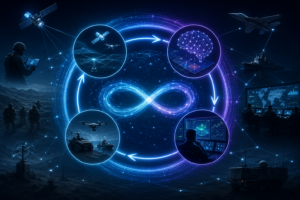
Thus, what once appeared as a sequence of discrete stages now assumes characteristic features of a continuously adaptive cycle operating across networks of humans and machines.
This creates what may be termed “cognitive compression”: the shrinking of the interval between sensing and action such that meaningful human intervention can become increasingly difficult. In highly contested environments, decisions often need to occur within seconds or fractions of seconds, as adversaries employing AI-enabled systems may generate operational tempos beyond the capacity of purely human-directed forces to effectively counter.
This presents a significant challenge, as while delegating greater authority to AI systems may provide operational advantages, it remains important to maintain established levels of human oversight and accountability as machine-enabled systems generate increasing speed and responsiveness. In this light, it becomes clear that command will increasingly need to encompass the orchestration of both human and machine cognition within a common operational framework.
Within such a framework of compressed operational timelines, commanders will interact less with isolated decisions and more with systems generating and executing myriad interconnected decision cycles almost simultaneously. Hence, as the titular question bespeaks, the future of warfare may be characterized by the evolution of the loop itself, from a largely linear model of decision-making into a continuously adaptive process of human-machine cognition.
Drones as Nodes of Cognition
Military discourse and popular media often portray drones as platforms. But it’s more accurate to regard the next generation of unmanned systems as nodes within larger cognitive ecosystems, given that their significance lies in their ability to communicate, collaborate, and adapt collectively within operational networks. As such, drones function as participants within distributed decision architectures that blend sensing, analysis, coordination, and action. Their operational value increasingly derives from both their contribution to collective cognition as well as their individual performance.
Drone swarms can identify objectives, allocate tasks, and reconfigure operational behavior dynamically in response to changing battlefield conditions. In such environments, individual drone actions are the result of interactions among multiple software agents, machine learning models, sensors, and communications architectures.
This challenges traditional assumptions about authorship and attribution. When swarms of iteratively autonomous systems interact within a distributed battlespace, questions of attribution and responsibility can become clouded, yet they remain essential to military command, legal accountability, and strategic legitimacy.
Mission Command Meets Machine Decision-Making
The Army’s philosophy of mission command provides a valuable starting point for addressing these challenges. Mission command emphasizes decentralized execution guided by commander intent, and subordinates who are empowered to adapt to changing conditions while remaining aligned with overarching objectives. The model recognizes inevitability of uncertainty, and the essentiality of initiative to battlefield success.
We believe that this construct affords a practical vector and nexus to merge responsible C2 into an ecosystem of AI-enabled warfare. The concept of mission command recognizes the operational effectiveness of distributing action across a force while maintaining coherence through intent. Machine-enabled cognition expands both the scale and speed at which such distribution can occur.
AI-enabled systems, at first glance, appear compatible with this construct. Like subordinate commanders, intelligent systems can receive objectives rather than detailed instructions, may adapt dynamically to environmental conditions and execute actions without constant supervision. Yet, a critical distinction remains; namely, human subordinates possess moral agency; machines operate through computational processes optimized toward defined objectives.
Thus, as Army formations incorporate AI-enabled systems into operational decision cycles, they confront the unique challenge of creating machine initiative while preserving meaningful human authority. The significance of this challenge becomes particularly apparent through the lens of the OODA loop. As observation, orientation, decision, and action increasingly occur across interconnected human-machine systems, command effectiveness correspondingly depends upon how well commander intent propagates throughout those processes. The enduring strength of mission command lies in its ability to create coherence within operational environments characterized by continuous adaptation.
Toward Synthesized Command and Control
From these challenges opportunity arises. To address these realities will require moving beyond traditional distinctions between human control and machine autonomy. Toward this end we propose a model of synthesized command and control (SYNTHComm), which recognizes that future military operations will involve integrated human-machine cognitive architectures. But rather than viewing AI systems as mere tools or independent actors, SYNTHComm engages them as contributors within a unified decisional ecosystem. SYNTHComm is particularly relevant in an environment where traditional command cycles are becoming increasingly compressed, as it (1) provides a framework for maintaining continuity between strategic objectives and operational execution as decision processes accelerate, and (2) seeks to preserve commander intent while leveraging machine speed, scale, and analytic capability.
Several principles define this approach: First, commander intent should remain the organizing framework through which AI systems operate. Machine actions must align with both specific tasks and higher-order operational objectives.
Second, accountability should remain traceable. Significant machine-generated recommendations and actions must be auditable, reconstructable, and attributable within established chains of command.
Third, authority should remain adjustable. Human leaders should calibrate machine autonomy according to mission requirements, operational conditions, and strategic risk.
Fourth, resilience should remain central. Systems must function effectively within degraded and contested information environments where communications, data integrity, and network access cannot be assumed.
Taken together, these principles may afford a foundational basis for integrating human judgment and machine cognition while concomitantly reinforcing command responsibility.
Implications for the Army
The implications for the Army extend far beyond drone employment to entail force structure, education, doctrine, training, and leader development; all of which require adaptation. It will be important for commanders to understand algorithmic behavior with equivalent fluency as previous generations’ understanding of operational principles intrinsic to defined missions.
Operational success will increasingly depend upon ability to supervise and direct human-machine teams working in concert with traditional formations. Doctrine must evolve to reflect and support these developing operational architectonics, in order to consider and provide guidance in circumstances wherein machine agents exercise delegated functions while (1) functioning in tandem with other human-machine hybrid units as well as solely human units; and (2) executing the tasks focal to operational success while remaining aligned with commander-directed intent. These changes carry particular significance in the multidomain operations where Army units operate across vast geographic regions and highly contested electromagnetic environments. Under such conditions, AI-enabled systems contribute to maintaining operational tempo and preserving battlefield awareness.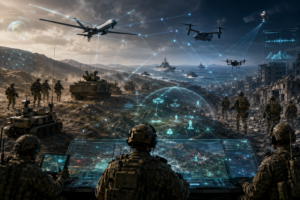
But we offer that perhaps the most critical challenge for the Army concerns the future of command itself. The challenge is predicated upon a basic contingency: As machine cognition becomes embedded throughout military operations, regnant assumptions about decision cycles, authority, accountability, and operational control face new pressures as competitive advantage becomes increasingly dependent upon integrating AI capabilities into command architectures.
Thus, to reiterate, the question posed by AI-enabled warfare is how the human-machine loop will evolve. Today, and in the future, OODA involves interconnected networks of human personnel, sensors, algorithms, autonomous systems, and decision-support tools. Accordingly, the OODA loop is acquiring new scale, speed, and complexity, ever more becoming a persistent process of distributed cognition that conjoins human judgment and machine-enabled analyses across multiple domains. Commanders will be engaged to shape the conditions, authorities, priorities, and intent through which these interconnected decision cycles operate; and understanding and adapting to this transformation may become one of the defining command challenges of the twenty-first century Army.
Indubitably, the OODA and human-machine loops remain viable and valuable constructs for competitive advantage, but their character is changing. The evolution of the loop might therefore be seen as a process of transformation. The future battlefield will continue to reward forces that learn, adapt, decide, and act more effectively than their adversaries. In twenty-first century conflicts, advantage will likely belong to the force that most effectively commands within an environment where these loops operate reciprocally, such that cognition is distributed to enable human judgment and machine intelligence to function as an integrated system of military power.
 If you enjoyed this post, check out the T2COM G-2’s Operational Environment Enterprise web page, brimming with authoritative information on the Operational Environment and how our adversaries fight.
About the Authors:
Dr. Elise Annett is a Research Fellow in the Program for Disruptive Technology and Future Warfare of the Institute for National Strategic Studies at the National Defense University.
Dr. James Giordano is Head of the Center for Strategic Deterrence and Studies of Weapons of Mass Destruction of the Institute for National Strategic Studies at the National Defense University, and serves as Special Advisor to the Assistant Secretary of War-CBRN.
Disclaimer: The views expressed in this blog post do not necessarily reflect those of the U.S. Department of War, Department of the Army, or the U.S. Army Transformation and Training Command (T2COM).