
[Editor’s Note: The Army’s Mad Scientist Laboratory is pleased to feature another post excerpting the findings from Team Axis Insight 2035‘s Project Deterrence Final Report. This Integrated Research Project documented the findings from the group’s United States Army War College (USAWC) Strategic Research Requirement portion of the Master of Strategic Studies degree program that occurred over the academic year (from November 2024 to April 2025).

Team Axis Insight 2035 consisted of COL Byron N. Cadiz, COL T. Marc Skinner, LTC Robert W. Mayhue, LTC Lori L. Perkins, and LTC Shun Y. Yu — all U.S. Army Officers and now proclaimed Army Mad Scientists! Team Axis Insight 2035‘s Project Deterrence Final Report documents their collective response to the following question posed by Ian Sullivan, U.S. Army Transformation and Training Command (T2COM) Headquarters Staff Transition Lead for Intelligence:
How are China, Russia, Iran, and North Korea likely to respond to U.S.-led deterrence efforts by 2035?
To date, the Mad Scientist Laboratory has excerpted Team Axis Insight 2035‘s findings addressing:
“An entangled future of situational cooperation and transactional inter-dependence among China, Russia, Iran, and North Korea” in Project Deterrence — An Entangled Future
How our adversaries are likely to integrate “four future capabilities … to create an environment where U.S. deterrence is neutralized: quantum warfare, swarm supremacy, hypersonic strike, and metamaterials” in Project Deterrence – Disruptive Technologies
How our adversaries are employing gray zone activities to “saturate the competition continuum below the level of armed conflict” and achieve a state of persistent coercion in Project Deterrence – Persistent Coercion
How China is “challenging the United States’ dominance in the Space domain” and the “operational impacts of ceding the Space Domain’s high ground to our sole pacing threat” in Race for the Final Frontier: Why China is Highly Likely to Overtake the U.S. in Space Dominance by 2035
In today’s post, proclaimed Mad Scientist COL Cadiz returns to provide us with an intriguing assessment of how China’s innovative convergence of emergent technologies is “highly likely”* to erode U.S. and Allied technological superiority in next ten years’ time — Read on!]
Executive Summary
 By 2035, China is highly likely (71–85%)* to undermine U.S. and allied technological superiority through centralized investments in emerging technologies such as quantum computing, artificial intelligence (AI), and space systems. This strategic focus enables China to bypass Western bureaucratic constraints and target critical C5ISR (i.e., Command, Control, Communications, Computers, Cyber, Intelligence, Surveillance, and Reconnaissance) systems essential to modern military operations. Concurrently, China is leveraging dual-use technologies, disinformation campaigns, cyber intrusions, and nonattributable attacks to exploit the gray zone, operating below the threshold of war to disable key systems and fracture allied cohesion. When combined, these capabilities position China to achieve strategic surprise by blinding and paralyzing U.S. and allied responses during crises, particularly in contested regions like Taiwan and the South China Sea, thereby shifting the global balance of power without initiating full-scale conflict.
Discussion

China’s concerted push to dominate quantum computing, AI, and space systems reflects a strategic intent to neutralize the U.S. and its allies’ longstanding advantages in C5ISR. Unlike the fragmented and often bureaucratically constrained Western approach, China employs a centralized model that aligns state funding, military doctrine, and civilian tech development under a unified national strategy. By prioritizing dual-use innovation, Beijing ensures that scientific breakthroughs rapidly translate into operational military capabilities. These advances threaten to upend the foundational elements of Western defense, making current encryption standards, satellite architectures, and real-time decision networks increasingly vulnerable to disruption (see the figure below).
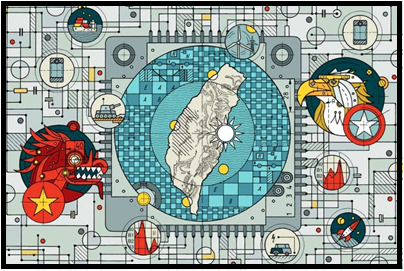
US-China Innovation Race / Source: foreignpolicy.com
The integration of quantum computing and AI is particularly disruptive. Quantum enabled decryption could expose secure military communications, enabling China to harvest intelligence, track operations, and degrade mission planning long before conflict begins. Simultaneously, AI-enhanced decision support systems will allow Chinese commanders to process battlefield data and execute operations faster than their U.S. counterparts, thereby shortening decision cycles and increasing the probability of successful first strikes. China’s ability to simulate entire battlespaces in real time and predict adversary responses offers a decisive edge in shaping outcomes without ever firing a shot, thereby blurring the line between deterrence and active engagement.
 China’s growing use of non-kinetic gray zone tactics presents an equally urgent challenge. By leveraging its technological edge in cyber operations, disinformation campaigns, and electromagnetic spectrum manipulation, China can coerce, confuse, and fragment adversaries without triggering conventional military responses. Cyber intrusions into critical infrastructure, AI-driven psychological operations, and jamming of satellite constellations all fall beneath the threshold of armed conflict but carry strategic effects. These tools enable Beijing to undermine alliance cohesion, influence public perception, and delay U.S. or NATO mobilization especially during crises in contested zones such as the South China Sea or Taiwan Strait.
Moreover, China’s advancements in space warfare, particularly through anti-satellite (ASAT) capabilities and the deployment of satellite mega-constellations, will further disrupt U.S. and allied situational awareness. The PLA’s doctrine of “active defense” in space anticipates the use of reversible  and deniable space attacks such as dazzling, spoofing, or cyber interference in order to temporarily degrade U.S. satellite networks in the opening phases of conflict. In doing so, China could blind intelligence and targeting systems, paralyze command and control, and gain space superiority, thus setting the conditions for rapid, localized gains before the West can effectively respond.
Despite growing investments by the United States and its allies in quantum-safe encryption, AI ethics frameworks, and resilient space architectures, these efforts are often siloed, slow-moving, and fragmented across bureaucratic boundaries. Without greater coordination, speed, and adaptability, Western initiatives risk falling behind China’s unified, state-driven strategy. At the same time, Europe’s lack of a unified defense posture simplifies China’s strategic calculus and reinforces its ability to conduct synchronized, deniable actions across domains. Unless the U.S. and its allies prioritize integrated countermeasures and prepare for gray zone competition as a persistent state rather than a precursor to war, they risk strategic paralysis before any kinetic engagement even begins.
Analytic Confidence
Analytic confidence is assessed as moderate, grounded in corroborated evidence drawn from six thoroughly evaluated Short Form Analytic Reports and reinforced by over 50 independently validated sources from U.S., Asia, and Europe spanning academic, governmental, military, economic, and technical domains. All sources conform to the standards of the Words of Estimated Probability methodology. Nevertheless, the assessment remains subject to potential revision, given the dynamic nature of technological innovation and the evolving contours of geopolitical alignments, which may introduce new variables or alter current trajectories.
* Kesselman List of Estimative Words:

If you enjoyed this post, check out Team Axis Insight 2035‘s previously excerpted posts:
Project Deterrence — An Entangled Future
Project Deterrence – Disruptive Technologies
Project Deterrence – Persistent Coercion
Explore the T2COM G-2‘s Operational Environment Enterprise web page, brimming with authoritative information on the Operational Environment and how our adversaries fight, including:
Our T2COM OE Threat Assessment 1.0, The Operational Environment 2024-2034: Large-Scale Combat Operations
Our China Landing Zone, full of information regarding our pacing challenge, including ATP 7-100.3, Chinese Tactics, T2COM OE Threat Assessment 1-1, How China Fights in Large-Scale Combat Operations, 10 Things You Didn’t Know About the PLA, and BiteSize China weekly topics.
Our Russia Landing Zone, including T2COM OE Threat Assessment 1-2, How Russia Fights in Large-Scale Combat Operations and the BiteSize Russia weekly topics. If you have a CAC, you’ll be especially interested in reviewing our weekly RUS-UKR Conflict Running Estimates and associated Narratives, capturing what we learned about the contemporary Russian way of war in Ukraine over the past two years and the ramifications for U.S. Army modernization across DOTMLPF-P.
Our Iran Landing Zone, including the Iran Quick Reference Guide and the Iran Passive Defense Manual (both require a CAC to access).
Our North Korea Landing Zone, including Resources for Studying North Korea, Instruments of Chinese Military Influence in North Korea, and Instruments of Russian Military Influence in North Korea.
Our Irregular Threats Landing Zone, including TC 7-100.3, Irregular Opposing Forces, and ATP 3-37.2, Antiterrorism (requires a CAC to access).
Our Running Estimates SharePoint site (also requires a CAC to access) — documenting what we’re learning about the evolving OE. Contains our monthly OE Running Estimates, associated Narratives, and the quarterly OE Assessment Intelligence Posts.
Then review the following related content…
… on Space:
Building Beyond: Preparing the Army for Lift-Off and associated podcast, with Dr. Olga Bannova
LSCO, PNT, and the Space Domain, by CPT Matthew R. Bigelow
Space: Challenges and Opportunities
Star Wars 2050 and The Final Frontier: Directed Energy Applications in Outer Space, by proclaimed Mad Scientist Marie Murphy
Beyond Space and associated podcast, with proclaimed Mad Scientist Kara Cunzeman
Space 2035: A Surplus of Uncertainty and a Deficit of Trust, by Maj Rachel Reynolds
… on AI:
Hybrid Intelligence: Sustaining Adversary Overmatch and associated podcast, with proclaimed Mad Scientist Dr. Billy Barry and LTC Blair Wilcox
Artificial Intelligence (AI) Trends
Takeaways Learned about the Future of the AI Battlefield and associated information paper
Artificial Intelligence: An Emerging Game-changer
Training Transformed: AI and the Future Soldier, by proclaimed Mad Scientist SGM Kyle J. Kramer
Rise of Artificial Intelligence: Implications to the Fielded Force, by John W. Mabes III
Integrating Artificial Intelligence into Military Operations, by Dr. James Mancillas
“Own the Night” and the associated Modern War Institute podcast, with proclaimed Mad Scientist Bob Work
Bringing AI to the Joint Force and associated podcast, with Jacqueline Tame, Alka Patel, and Dr. Jane Pinelis
… on Quantum Computing:
Quantum Surprise on the Battlefield? by proclaimed Mad Scientist Elsa Kania
Quantum Conundrum: Multi-domain Threats, Convergent Technology & Hybrid Strategy, by Robert McCreight
A Strategy for Everything: Quantum Artificial Intelligence, Quantum Multiverse, and Feedback Loop of Finite Information, by Victor R. Morris
About the Author: Byron Cadiz is a Colonel in the U.S. Army National Guard and recent graduate of the Army War College. He previously served as the State Army Aviation Officer for the Hawaii Army National Guard, and has commanded the 103rd Troop Command and Company B, 1st Battalion, 171st Aviation Regiment. He has also participated in international exercises like Gema Bhakti with the Tentara Nasional Indonesia (Indonesian National Armed Forces).
Disclaimer: The views expressed in this blog post do not necessarily reflect those of the U.S. Department of Defense, Department of the Army, or the Transformation and Training Command (T2COM).